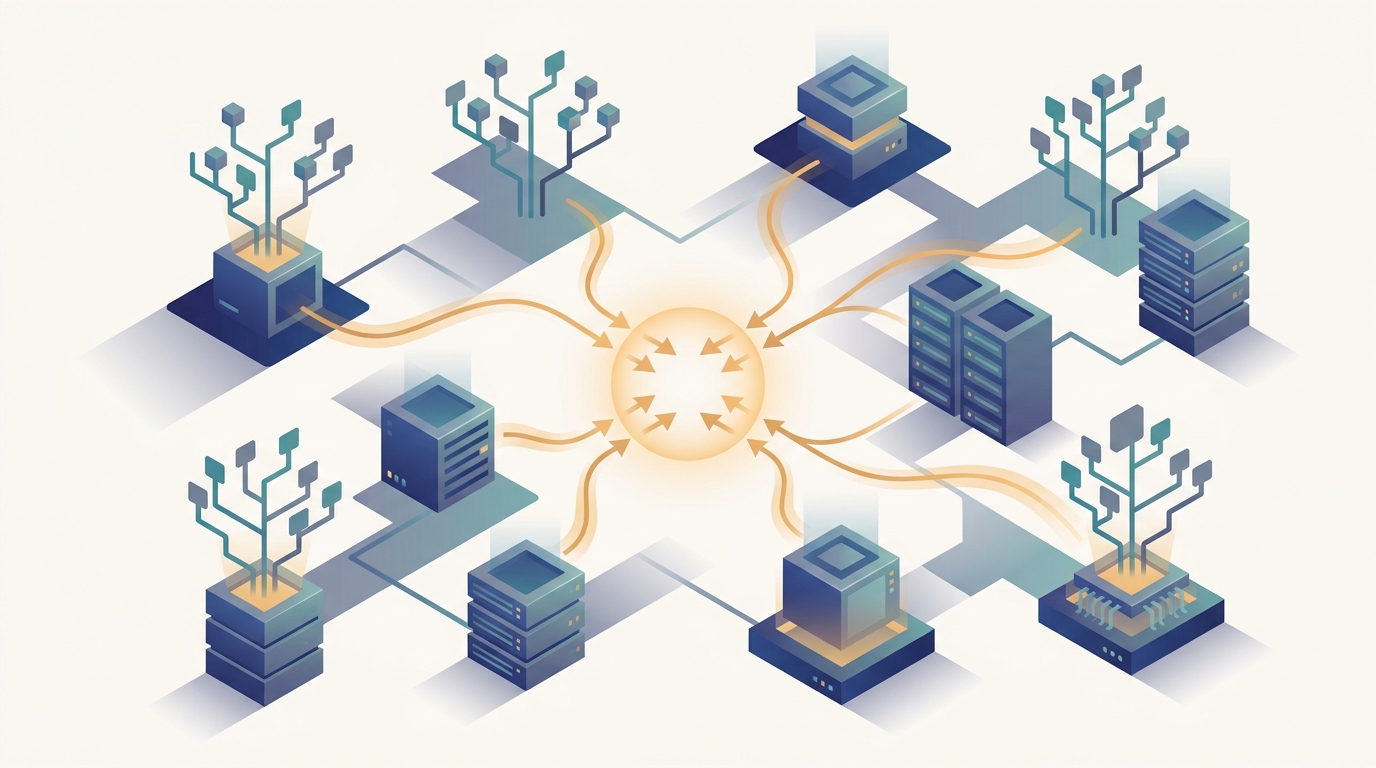
"They sent me a hundred million rows and asked for the best split. I do not hold the rows. I hold a histogram of them, gathered from forty workers who each saw a slice, and from that summary alone I must choose where the tree branches."
A Split-Finder Working Only From Aggregates
Chapter Overview
This is the third chapter of Part III, and it is the one that connects the distribution machinery of the first two chapters to the algorithms most practitioners actually deploy. Chapter 10 gave you the distributed gradient and Chapter 11 gave you the parameter server, but both used a deep-network-shaped model as the running example. This chapter takes the classical canon, the linear models, kernel machines, trees, ensembles, clustering, and nearest-neighbor search that dominate tabular and retrieval workloads, and asks the same question of each: when the data no longer fits on one machine, what exactly has to travel between machines, and which distributed primitive carries it. The answer is different for each family, and that difference is the spine of the chapter.
Read in order, the seven sections take you from "fit a line to data that does not fit on one disk" to "search a billion vectors in milliseconds across a cluster," and they show that the distributed primitive changes with the algorithm: a gradient sum for the linear models, a histogram gather for the trees, a centroid reduce for clustering, and a sharded fan-out for nearest-neighbor search. This is the chapter where the abstract patterns of Chapters 10 and 11 become a concrete toolkit, and where the approximate nearest-neighbor index built in the last section reappears as the retrieval backbone of distributed vector search in Part V.
Prerequisites
This chapter assumes the two chapters that opened Part III. From Chapter 10: Distributed Optimization you carry the data-parallel gradient, synchronous and asynchronous distributed SGD, and the all-reduce that sums partial gradients across workers; the linear models of Section 12.1 and the SVM solver of Section 12.2 are exactly that machinery applied to convex objectives, and the iterative reduces of clustering in Section 12.6 reuse the same synchronization pattern. From Chapter 4: Communication Primitives for Distributed Training you carry the collective operations, all-reduce, all-gather, and broadcast, that move histograms, centroids, and candidate sets between machines, and the bandwidth-and-latency reasoning that tells you when a histogram gather is cheaper than shipping the data. The chapter assumes comfortable Python and scikit-learn-style model APIs, single-machine versions of each algorithm (ordinary least squares, the SVM margin, the decision-tree split criterion, k-means, and a nearest-neighbor query), and the basic convex-optimization and linear-algebra background refreshed in Appendix A: Mathematical Background. Familiarity with the parameter-server sharding of Chapter 11: Parameter Servers and Distributed Embeddings helps with the sharded indexes of Section 12.7 but is not required.
Learning Objectives
- Cast linear and logistic regression as data-parallel convex optimization, and show how each worker's partial gradient is summed by an all-reduce or a parameter-server push-pull to train on data that does not fit on one machine.
- Explain the communication-efficient distributed training of support vector machines, identifying what work stays local on each shard and what little must be synchronized across the cluster.
- Describe how a decision-tree split is chosen from aggregated feature histograms rather than from raw data, and name the gather-and-reduce primitive that makes distributed split-finding scale.
- Contrast the near-trivial parallelism of random forests, whose independent trees train with almost no coordination, with the sequential dependency that makes distributed gradient boosting hard.
- Explain how XGBoost and LightGBM distribute gradient boosting through histogram-based split-finding and feature-or-data partitioning, and reason about their communication cost per boosting round.
- Express distributed k-means as a MapReduce-shaped iteration, a map over points to nearest centroids and a reduce that recomputes centroids, and relate scalable k-means initialization to it.
- Describe how a billion-vector approximate nearest-neighbor index is sharded across machines and queried by fan-out and merge, and connect the structure to distributed vector search in later parts.
Chapter Roadmap
- 12.1 Distributed Linear and Logistic Regression Casts the two foundational linear models as data-parallel convex optimization, where each worker computes a partial gradient on its shard and an all-reduce or parameter-server push-pull sums them into one update.
- 12.2 Distributed Support Vector Machines Trains the maximum-margin classifier across a cluster with a communication-efficient solver that keeps most of the optimization local to each data shard and synchronizes only sparingly.
- 12.3 Distributed Decision Trees Shifts the distributed primitive from summing gradients to summing histograms, choosing each split from per-feature statistics gathered and reduced across the workers that hold the data.
- 12.4 Random Forests at Scale Exploits the near-perfect parallelism of an ensemble of independent trees, training each on a bootstrap sample with almost no coordination and combining their votes at the end.
- 12.5 Distributed Gradient Boosting Confronts the sequential dependency that makes boosting hard to distribute, and shows how XGBoost and LightGBM scale it through histogram-based split-finding and feature-or-data partitioning.
- 12.6 Distributed Clustering Expresses k-means as a MapReduce-shaped iteration, a map of points to nearest centroids and a reduce that recomputes them, and scales the initialization to match.
- 12.7 Distributed Approximate Nearest Neighbors Shards a billion-vector index across machines and answers each query by fan-out and merge, the retrieval structure that returns as distributed vector search in later parts.
What's Next?
This chapter scaled the classical canon across a cluster, the linear and kernel models on a gradient sum, the trees and boosted ensembles on a histogram gather, and clustering and nearest-neighbor search on a reduce and a sharded fan-out. Chapter 13: Distributed Graph Machine Learning takes the next step in generality, from data that arrives as independent rows to data that arrives as a graph, where each example is connected to others and the computation must follow the edges. Graph algorithms and graph neural networks raise a distribution problem the methods here did not face: the data cannot be sharded into independent pieces, because partitioning a graph cuts edges that the computation needs, so the chapter develops graph partitioning, the gather-scatter-apply pattern of vertex-centric computation, and the sampling tricks that make message passing tractable at billion-edge scale. Read it next, and watch the clean shard-and-reduce of this chapter give way to the harder problem of computing over data whose pieces refuse to come apart.
Bibliography & Further Reading
Distributed Frameworks and Linear Models
Meng, X., Bradley, J., Yavuz, B., Sparks, E., Venkataraman, S., Liu, D., et al. "MLlib: Machine Learning in Apache Spark." Journal of Machine Learning Research, 2016. jmlr.org
The reference for Spark's distributed machine-learning library, describing how linear models, trees, and clustering are implemented over a data-parallel engine, the production setting for most of this chapter.
Smith, V., Forte, S., Ma, C., Takac, M., Jordan, M. I., Jaggi, M. "CoCoA: A General Framework for Communication-Efficient Distributed Optimization." arXiv:1611.02189, 2016. arxiv.org/abs/1611.02189
The communication-efficient framework that does most of the optimization locally on each shard, the basis for the distributed linear models of Section 12.1 and the SVM solver of Section 12.2.
Trees, Forests, and Gradient Boosting
Breiman, L. "Random Forests." Machine Learning, 45(1), 2001. link.springer.com
The original random-forest paper, defining the ensemble of independent bootstrap-trained trees whose embarrassing parallelism makes Section 12.4 the easiest distribution in the chapter.
Chen, T., Guestrin, C. "XGBoost: A Scalable Tree Boosting System." KDD, 2016. arxiv.org/abs/1603.02754
The system paper for the most widely used gradient-boosting library, whose distributed histogram-based split-finding is the centerpiece of Section 12.5.
Ke, G., Meng, Q., Finley, T., Wang, T., Chen, W., Ma, W., et al. "LightGBM: A Highly Efficient Gradient Boosting Decision Tree." NeurIPS, 2017. papers.nips.cc
The boosting library whose histogram algorithm, gradient-based sampling, and feature bundling cut the communication and compute of distributed split-finding, the second pillar of Section 12.5.
Distributed Clustering
Bahmani, B., Moseley, B., Vattani, A., Kumar, R., Vassilvitskii, S. "Scalable K-Means++." arXiv:1203.6402, 2012. arxiv.org/abs/1203.6402
The parallel initialization (k-means||) that replaces the sequential k-means++ seeding with a small number of distributed sampling rounds, the scalable initializer of Section 12.6.
Approximate Nearest-Neighbor Search
Johnson, J., Douze, M., Jegou, H. "Billion-Scale Similarity Search with GPUs (FAISS)." arXiv:1702.08734, 2017. arxiv.org/abs/1702.08734
The FAISS paper for billion-vector similarity search on GPUs, the engine behind the sharded indexes and fan-out queries of Section 12.7.
Malkov, Y. A., Yashunin, D. A. "Efficient and Robust Approximate Nearest Neighbor Search Using Hierarchical Navigable Small World Graphs (HNSW)." arXiv:1603.09320, 2016. arxiv.org/abs/1603.09320
The HNSW graph index that gives logarithmic-time approximate search and is the per-shard structure most distributed nearest-neighbor systems in Section 12.7 build on.
Jegou, H., Douze, M., Schmid, C. "Product Quantization for Nearest Neighbor Search." IEEE TPAMI, 33(1), 2011. ieeexplore.ieee.org
The product-quantization method that compresses vectors so a billion of them fit in memory across a cluster, the storage backbone of the indexes in Section 12.7.
Subramanya, S. J., Devvrit, F., Simhadri, H. V., Krishnaswamy, R., Kadekodi, R. "DiskANN: Fast Accurate Billion-Point Nearest Neighbor Search on a Single Node." NeurIPS, 2019. papers.nips.cc
The DiskANN index that pushes billion-point search onto SSD-backed nodes, the cost-efficient building block that shards into the distributed retrieval of Section 12.7.