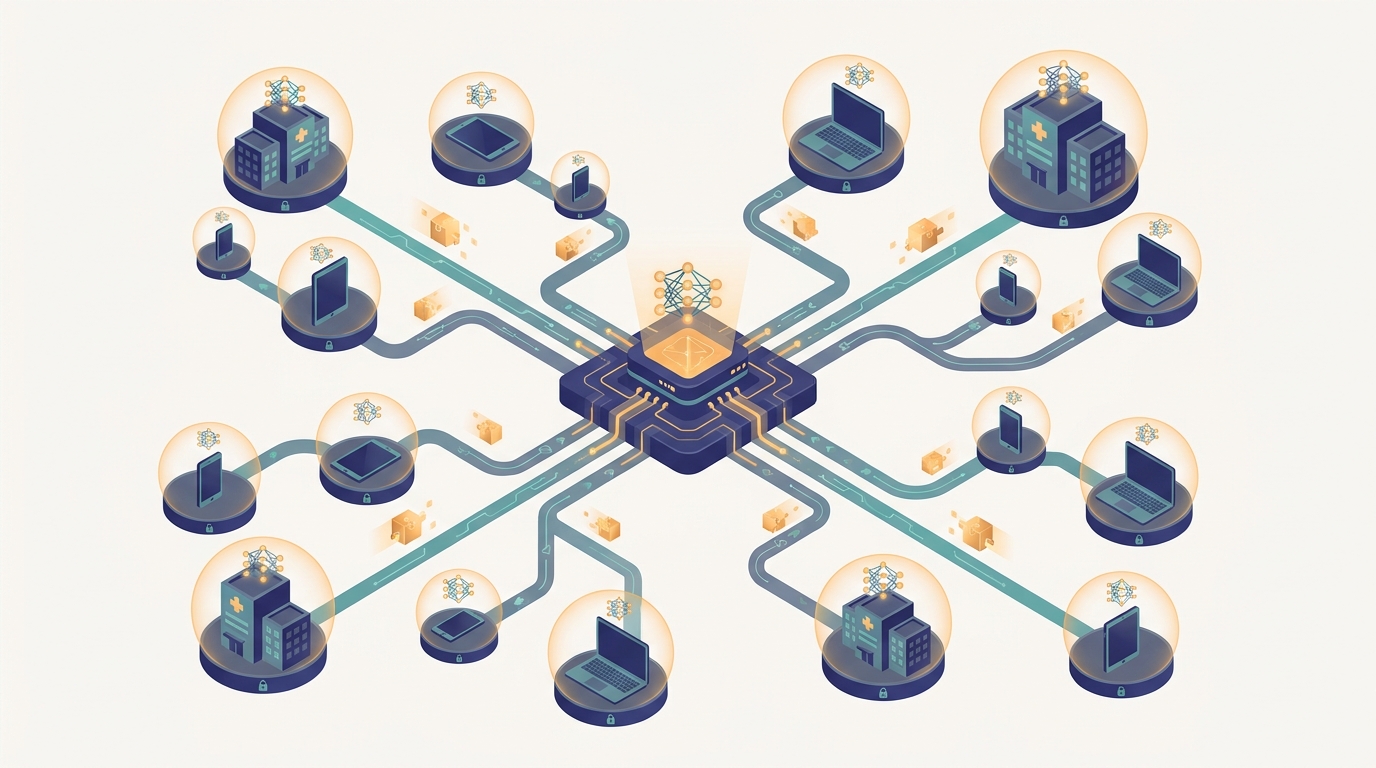
"I never see the data. A million phones train in the dark and mail me their second thoughts; I average the whispers, send the model back, and hope nobody charged less than half a battery overnight."
A Federated Coordinator Who Has Learned to Trust the Average
Chapter Overview
This is the fifth and final chapter of Part III, and it closes the part by dropping the assumption that has quietly held through every distributed method so far: that you own the training data and may move it wherever the computation is. Chapter 10 ran distributed SGD over shards the scheduler scattered; Chapters 11 and 12 sharded parameters and classical models the same way; Chapter 13 spread a single graph across a cluster you controlled. In all of them the data was yours to co-locate. Federated learning begins where that ends. The data is generated and retained on the participants, phones, hospitals, banks, and edge sensors, and it must not leave them. The whole chapter is organized around training a shared model under that one binding constraint, and around the three difficulties the constraint creates: heterogeneous data, scarce communication, and privacy.
Read in order, the nine sections take you from "the data is on a billion phones and the law forbids collecting it" to "train, personalize, privately aggregate, and decentralize a model that those phones never give up." The thread to watch is that federation reframes every quantity the rest of the book optimized: the gradient is now a biased estimate because the shards are not IID, the communication budget is measured in rounds rather than bytes per step, and the aggregation must reveal nothing about any single participant. The local-SGD-and-average move of Chapter 10 reappears in every section, but it now runs on data you cannot inspect, over participants who come and go, under a privacy boundary you are not permitted to cross.
Prerequisites
This chapter assumes the distributed-optimization background of the earlier part. From Chapter 10: Distributed Optimization you carry the single most important idea, local SGD: the move of taking several gradient steps on local data before communicating, rather than synchronizing every step, because FedAvg is local SGD pushed to its extreme, many local epochs between rare communication rounds, and the convergence reasoning of Sections 14.3 through 14.5 builds directly on the local-SGD analysis you saw there. From the same chapter you carry the data-parallel gradient and the synchronous-versus-asynchronous tradeoff, which return as the server-coordinated rounds of FedAvg and the server-free gossip of Section 14.8. From Chapter 4: Communication Primitives for Distributed Training you carry all-reduce and the cost of a communication round, which decentralized learning in Section 14.8 replaces with neighbor-averaging over a gossip topology. The chapter assumes comfortable Python, a working understanding of mini-batch SGD and of training a neural network, and basic probability, since non-IID data in Section 14.4 is a statement about differing local distributions. The differential-privacy and secure-aggregation material in Section 14.6 is developed from first principles and assumes no prior cryptography.
Learning Objectives
- Explain why some training data cannot be centralized, naming the regulatory, bandwidth, and privacy pressures that make federated learning the only viable path, and contrast the data-stays-put model with the data-parallel sharding of earlier chapters.
- Distinguish cross-device from cross-silo federated learning along the axes of participant count, reliability, statefulness, and trust, and explain how the regime dictates the algorithm and system design.
- Derive FedAvg as local SGD with periodic averaging, implement one communication round, and describe how FedProx and SCAFFOLD correct the client drift that heterogeneous data induces.
- Explain why non-identically-distributed client data breaks the unbiased-gradient assumption of distributed SGD and characterize its effect on convergence and final accuracy.
- Reason about the communication constraints of federation, why the budget is measured in rounds rather than messages, and apply gradient compression, quantization, and reduced communication frequency to fit it.
- Describe how secure aggregation lets a server combine client updates it can never read individually, and how differential privacy bounds what the released model reveals about any one participant.
- Contrast a single global model with personalized federated learning, and explain how meta-learning, fine-tuning, and multi-task formulations fit a model to each participant's distribution.
- Explain decentralized learning as server-free neighbor averaging over a gossip topology, and reason about how the topology controls the speed of consensus.
- Identify the constraints that battery, intermittent connectivity, and limited memory impose on edge and on-device learning, and describe the techniques that make training feasible there.
Chapter Roadmap
- 14.1 Motivation for Federated Learning Lays out the regulatory, bandwidth, and privacy pressures that make centralizing training data impossible, and frames federated learning as training a shared model while the data stays on the devices and silos that hold it.
- 14.2 Cross-Device and Cross-Silo Learning Separates the two regimes that dominate practice, federation across millions of unreliable stateless phones and federation across a handful of trusted stateful institutions, and shows how the regime dictates every later design choice.
- 14.3 FedAvg and Its Variants Develops FedAvg as local SGD with periodic averaging, the algorithm at the heart of the field, and the variants FedProx and SCAFFOLD that correct the client drift heterogeneous data induces.
- 14.4 Non-IID Data Confronts the central difficulty of federation, that client data is not identically distributed, and shows why this breaks the unbiased-gradient assumption of distributed SGD and degrades convergence and final accuracy.
- 14.5 Communication Constraints Treats the communication budget that makes each round expensive and rare, and applies gradient compression, quantization, and reduced communication frequency to fit training into it.
- 14.6 Privacy and Secure Aggregation Develops secure aggregation, which lets a server combine client updates it can never read individually, and differential privacy, which bounds what the released model can reveal about any single participant.
- 14.7 Personalized Federated Learning Replaces the single global model with one fitted to each participant, through meta-learning, fine-tuning, and multi-task formulations that respect the local distribution rather than averaging it away.
- 14.8 Decentralized Learning Removes the central server entirely, averaging models over a gossip topology of neighbor exchanges, and reasons about how the communication graph controls the speed of consensus.
- 14.9 Edge and On-Device Learning Lands the whole apparatus on battery-limited, intermittently connected, memory-constrained hardware, and surveys the techniques that make training in the field feasible at all.
What's Next?
This chapter closes Part III, and with it the assumption that you own and can co-locate your training data, an assumption that held quietly through distributed optimization, parameter servers, classical machine learning, and distributed graph learning, and finally fell away here. Part IV turns from the question of where the data lives to the question of how to train a single very large model fast, and it returns to the world where you own a tightly coupled cluster and the data is yours to scatter. Chapter 15: Data-Parallel Deep Learning opens that part by taking the data-parallel gradient of Chapter 10 and engineering it for deep networks on many accelerators: replicating the model across GPUs, overlapping the backward pass with gradient all-reduce, bucketing and scheduling the communication, and scaling the batch without wrecking convergence. The local-SGD intuition you built here returns there as one point on a spectrum that runs from synchronous every-step all-reduce to the rare-communication federation you just left. Read it next, and watch the federated coordinator's patient averaging tighten back into the microsecond-budgeted all-reduce of a training cluster that owns every byte of its data.
Bibliography & Further Reading
Foundations and Surveys
McMahan, B., Moore, E., Ramage, D., Hampson, S., Aguera y Arcas, B. "Communication-Efficient Learning of Deep Networks from Decentralized Data (FedAvg)." arXiv:1602.05629, 2016. arxiv.org/abs/1602.05629
The paper that introduced federated learning and the FedAvg algorithm of local SGD plus periodic averaging, the starting point for the entire chapter and the core of Section 14.3.
Kairouz, P., McMahan, H. B., et al. "Advances and Open Problems in Federated Learning." arXiv:1912.04977, 2019. arxiv.org/abs/1912.04977
The comprehensive survey that frames cross-device versus cross-silo federation, non-IID data, privacy, and communication, the organizing reference behind Sections 14.1, 14.2, and 14.6.
FedAvg Variants and Heterogeneity
Li, T., Sahu, A. K., Zaheer, M., Sanjabi, M., Talwalkar, A., Smith, V. "Federated Optimization in Heterogeneous Networks (FedProx)." arXiv:1812.06127, 2018. arxiv.org/abs/1812.06127
The proximal-term variant of FedAvg that stabilizes training under heterogeneous data and stragglers, one of the two corrections developed in Section 14.3 and motivated by Section 14.4.
Karimireddy, S. P., Kale, S., Mohri, M., Reddi, S. J., Stich, S. U., Suresh, A. T. "SCAFFOLD: Stochastic Controlled Averaging for Federated Learning." arXiv:1910.06378, 2019. arxiv.org/abs/1910.06378
The control-variate method that corrects the client drift caused by non-IID data, the second FedAvg variant of Section 14.3 and a direct response to the difficulty in Section 14.4.
Privacy and Secure Aggregation
Bonawitz, K., Ivanov, V., Kreuter, B., Marcedone, A., McMahan, H. B., Patel, S., Ramage, D., Segal, A., Seth, K. "Practical Secure Aggregation for Privacy-Preserving Machine Learning." ACM CCS, 2017. dl.acm.org
The protocol that lets a server compute the sum of client updates without learning any individual update, the cryptographic core of the secure aggregation in Section 14.6.
McMahan, H. B., Ramage, D., Talwar, K., Zhang, L. "Learning Differentially Private Recurrent Language Models." arXiv:1710.06963, 2017. arxiv.org/abs/1710.06963
The work that combines federated training with differential privacy to bound what the released model reveals about any participant, the privacy half of Section 14.6.
Personalized Federated Learning
Fallah, A., Mokhtari, A., Ozdaglar, A. "Personalized Federated Learning: A Meta-Learning Approach (Per-FedAvg)." arXiv:2002.07948, 2020. arxiv.org/abs/2002.07948
The meta-learning formulation that trains an initialization each client can quickly adapt to its own distribution, the personalization approach developed in Section 14.7.
Decentralized Learning
Lian, X., Zhang, C., Zhang, H., Hsieh, C.-J., Zhang, W., Liu, J. "Can Decentralized Algorithms Outperform Centralized Algorithms? A Case Study for Decentralized Parallel SGD (D-PSGD)." arXiv:1705.09056, 2017. arxiv.org/abs/1705.09056
The analysis showing decentralized neighbor-averaging SGD can match centralized SGD while removing the central bottleneck, the foundation of the gossip-averaging view in Section 14.8.
Federated Foundation Models and Efficient Fine-Tuning
Zhang, Y., et al. "FedLLM: A Survey of Federated Learning for Large Language Models." arXiv:2503.12016, 2025. arxiv.org/abs/2503.12016
A comprehensive survey of federated fine-tuning of foundation models, covering FedLoRA, federated prompt tuning, communication efficiency, and the shifted privacy surface when adapter weights rather than full gradients are aggregated. The primary reference for Section 14.9's discussion of federated fine-tuning at scale.
Security: Gradient Inversion and Byzantine Robustness
Zhu, L., Liu, Z., Han, S. "Deep Leakage from Gradients." NeurIPS 2019. arXiv:1906.08935. arxiv.org/abs/1906.08935
The paper that introduced gradient inversion, demonstrating that a client's training examples can be reconstructed near-exactly from the gradient it uploads, motivating the privacy hardening in Section 14.6.
Geiping, J., Bauermeister, H., Dröge, H., Moeller, M. "Inverting Gradients: How Easy Is It to Break Privacy in Federated Learning?" NeurIPS 2020. arXiv:2003.14053. arxiv.org/abs/2003.14053
Sharpened the gradient-inversion attack to work on larger batches and more realistic architectures, reinforcing the case that differential privacy is necessary alongside secure aggregation. Cited in Section 14.6's discussion of reconstruction attacks.
Carletti, M., et al. "SoK: Attacks and Defences in Federated Learning." USENIX Security 2025.
A systematization-of-knowledge paper surveying the full attack-and-defence landscape for federated aggregation, including poisoning, backdoor, and gradient-inversion attacks and the robust aggregation rules (Krum, coordinate-wise median, FLTrust) that defend against them. The primary reference for Byzantine robustness in Section 14.6.
Frameworks and Tools
Beutel, D. J., Topal, T., Mathur, A., Qiu, X., Fernandez-Marques, J., Gao, Y., Sani, L., Li, K. H., Parcollet, T., de Gusmao, P. P. B., Lane, N. D. "Flower: A Friendly Federated Learning Framework." flower.ai
The framework-agnostic federated learning library used to prototype the FedAvg rounds, client sampling, and aggregation strategies that run through Sections 14.3 to 14.7.
Google. "TensorFlow Federated: Machine Learning on Decentralized Data." tensorflow.org/federated
The open-source stack for expressing federated computations and simulating cross-device training, a reference implementation for the algorithms of this chapter.