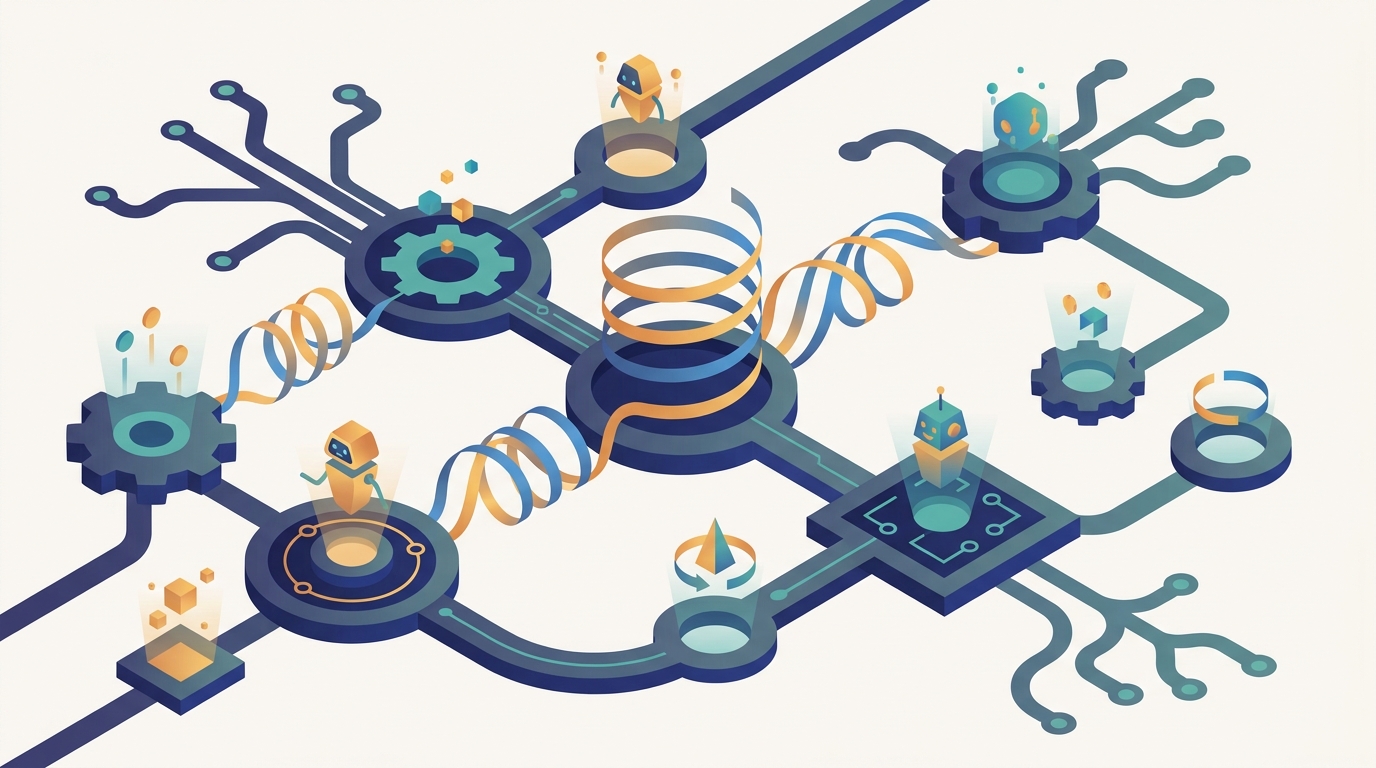
"I trained my policy to perfection against a fixed opponent. Then the opponent started learning too, and every lesson I had carefully memorized became wrong at exactly the same speed I learned it."
A Q-Function Chasing a Moving Target
Chapter Overview
This is the learning chapter of Part VI, and its subject is the gap between an agent that follows a designed policy and an agent that discovers one through reward, in a world where it is not the only one learning. The ten sections develop that subject in order. They begin by carrying single-agent reinforcement learning into the multi-agent setting and naming what breaks, then formalize the setting as a Markov game, then sort the field by the structure of the agents' rewards. From there they build the algorithmic toolkit: independent learning, centralized training with decentralized execution, value decomposition, policy gradients, and credit assignment, before confronting non-stationarity head-on and closing with the distributed systems that train these populations at scale. The through-line is the moving target. Every agent learns against an environment that includes other learners, so the optimization problem each one faces refuses to stand still.
Read in order, the ten sections take you from "here is reinforcement learning for one agent" to a working understanding of how a population of agents learns to act together or against each other: carry RL across the bridge, formalize the game, classify the reward structure, try the naive thing, centralize the training but decentralize the execution, decompose the value, scale with policy gradients, solve credit assignment, confront the moving target, and run the whole thing across a cluster. The argument is cumulative and it carries the strategic toolkit of Chapter 28 into learning dynamics: equilibria become the solution concepts that learning may or may not reach, and the cooperative and competitive games become the reward structures that decide which algorithms apply. The agent societies of Chapter 29 become populations that learn rather than follow scripts, and the thread runs straight out of the chapter into the collective behavior of Chapter 31, where coordination emerges from many simple agents rather than from learned policies over joint state.
Prerequisites
This chapter stands on the two chapters immediately before it in Part VI and on the reinforcement learning foundations the rest of the book assumes. From Chapter 28: Game-Theoretic Foundations for Multi-Agent AI you carry the strategic vocabulary that frames every learning problem here: what a game is, what an equilibrium means, the difference between cooperative and competitive interaction, and why an agent's best response depends on what everyone else does, because the Markov game of Section 30.2 is exactly the dynamic, state-bearing generalization of those matrix games. From Chapter 29: Multi-Agent Systems you carry the engineering picture of a society of autonomous agents acting on partial views inside a shared environment, since MARL is what happens when those agents learn their behaviors rather than have them designed. The chapter also assumes basic single-agent reinforcement learning: Markov decision processes, value functions, Q-learning, policy gradients, and the actor-critic pattern, the machinery this chapter generalizes from one agent to many. For the systems half of the chapter, it builds directly on Chapter 20: Distributed Reinforcement Learning Infrastructure, whose actor-learner architectures, distributed experience collection, and replay systems return in Section 30.10 as the engine that trains multi-agent populations at scale. Light formal notation and the ability to read pseudocode are assumed throughout, as in the rest of the book. No prior exposure to multi-agent learning is required; Section 30.1 builds the multi-agent setting from the single-agent case before anything is built on it.
Learning Objectives
- Explain how single-agent reinforcement learning extends to many agents, and identify precisely what breaks when more than one agent learns at once.
- Formalize a multi-agent learning problem as a Markov game, relating it to the single-agent Markov decision process and to the matrix games of Chapter 28.
- Classify a multi-agent setting as cooperative, competitive, or mixed by the structure of the agents' rewards, and reason about how that structure dictates the choice of algorithm.
- Compare independent learning against centralized training with decentralized execution, and explain when each is appropriate and why the centralized critic helps.
- Apply value decomposition methods such as VDN and QMIX to factor a team's joint action-value into learnable per-agent components.
- Develop multi-agent policy gradient methods such as MADDPG and MAPPO, and solve the credit-assignment problem of attributing shared reward to individual agents.
- Diagnose non-stationarity in multi-agent learning and apply the techniques that mitigate it, and scale MARL training across many machines using distributed reinforcement learning infrastructure.
Chapter Roadmap
- 30.1 From Reinforcement Learning to MARL Carries single-agent reinforcement learning across the bridge into many agents, naming precisely what changes when an agent must learn amid other agents who are learning too.
- 30.2 Markov Games Formalizes the multi-agent setting as a Markov game, the generalization of the Markov decision process to simultaneous decision-makers that recovers the matrix games of Chapter 28 as its stateless case.
- 30.3 Cooperative, Competitive, and Mixed Settings Sorts the field by the structure of the agents' rewards, distinguishing shared-reward teams, zero-sum opponents, and the mixed-motive settings in between that decide which algorithms apply.
- 30.4 Independent Learners Tries the naive thing first, treating each agent as a single-agent learner that ignores the others, and works out when this surprisingly strong baseline holds up and when it fails.
- 30.5 Centralized Training with Decentralized Execution Introduces the dominant MARL paradigm, using global information and a centralized critic at training time while keeping each agent's deployed policy fully decentralized.
- 30.6 Value Decomposition Factors a cooperative team's joint action-value into learnable per-agent components, developing VDN and QMIX and the monotonicity condition that makes decentralized greedy action consistent with centralized value.
- 30.7 Policy Gradient Methods in MARL Scales MARL to continuous and high-dimensional action spaces with multi-agent actor-critic methods such as MADDPG and MAPPO, built on centralized critics over the joint action.
- 30.8 Credit Assignment Attributes a shared team reward to the individual agents that earned it, developing counterfactual baselines such as COMA so each agent learns from its own contribution rather than the group's noise.
- 30.9 Non-Stationarity Confronts the central challenge directly, the moving target created when every agent's environment contains other learners, and develops the techniques that let learning converge despite it.
- 30.10 Distributed MARL Training Introduces mean-field MARL as the tractable approach for large populations: approximates the joint action distribution with the empirical mean, derives mean-field Q-learning, proves the O(1/sqrt(N)) approximation bound, and demonstrates scaling to 100-agent coordination tasks intractable for CTDE.
What's Next?
This chapter built the learning core of Part VI: how an agent discovers a policy by trial and reward when its environment contains other agents who are learning too, from the Markov game that formalizes the setting through value decomposition, policy gradients, credit assignment, and the distributed systems that train it all at scale. The agents here learn rich policies over joint state, and the central struggle is the non-stationarity that learning amid other learners creates. Chapter 31: Swarm Intelligence and Collective Behavior turns the problem inside out. Instead of a small number of agents each learning a sophisticated policy, it asks how coordinated, robust, global behavior can emerge from very many agents following very simple local rules, with no learned value function and no joint optimization at all. Where this chapter gave you populations that learn their coordination through reward, the next gives you populations whose coordination is an emergent property of simple interaction, flocking, stigmergy, and self-organization. Read Chapter 31 next, and watch coordination appear from the bottom up rather than being learned from the top down.
Bibliography & Further Reading
Foundations and Frameworks
Littman, M. L. "Markov Games as a Framework for Multi-Agent Reinforcement Learning." Proceedings of the Eleventh International Conference on Machine Learning (ICML), 1994. sciencedirect.com
The paper that cast multi-agent reinforcement learning as learning in a Markov game and introduced minimax-Q, the formal foundation for the Markov game setting of Section 30.2.
Tan, M. "Multi-Agent Reinforcement Learning: Independent vs. Cooperative Agents." Proceedings of the Tenth International Conference on Machine Learning (ICML), 1993. mit.edu
The early study contrasting independent Q-learners with cooperative agents that share information, the historical anchor for the independent-learning baseline of Section 30.4.
Centralized Training and Policy Gradients
Lowe, R., Wu, Y., Tamar, A., Harb, J., Abbeel, P., Mordatch, I. "Multi-Agent Actor-Critic for Mixed Cooperative-Competitive Environments (MADDPG)." arXiv:1706.02275, 2017. arxiv.org
The multi-agent actor-critic with centralized critics over the joint action that defined centralized training with decentralized execution, central to Sections 30.5 and 30.7.
Foerster, J., Farquhar, G., Afouras, T., Nardelli, N., Whiteson, S. "Counterfactual Multi-Agent Policy Gradients (COMA)." arXiv:1705.08926, 2017. arxiv.org
The counterfactual baseline that isolates each agent's contribution to a shared reward, the centerpiece of the credit-assignment treatment in Section 30.8.
Yu, C., Velu, A., Vinitsky, E., Gao, J., Wang, Y., Bayen, A., Wu, Y. "The Surprising Effectiveness of PPO in Cooperative Multi-Agent Games (MAPPO)." arXiv:2103.01955, 2021. arxiv.org
The study showing that a centralized-critic PPO is a strong, simple baseline across cooperative benchmarks, a workhorse method for the policy gradients of Section 30.7.
de Witt, C. S., Gupta, T., Makoviichuk, D., Makoviychuk, V., Torr, P. H. S., Sun, M., Whiteson, S. "Is Independent Learning All You Need in the StarCraft Multi-Agent Challenge? (IPPO)." arXiv:2011.09533, 2020. arxiv.org
The result that independent PPO learners are competitive with centralized methods on hard cooperative tasks, sharpening the independent-learner discussion of Section 30.4.
Value Decomposition
Sunehag, P., Lever, G., Gruslys, A., Czarnecki, W. M., et al. "Value-Decomposition Networks for Cooperative Multi-Agent Learning (VDN)." arXiv:1706.05296, 2017. arxiv.org
The additive factorization of a team's joint action-value into per-agent terms, the first value-decomposition method developed in Section 30.6.
Rashid, T., Samvelyan, M., de Witt, C. S., Farquhar, G., Foerster, J., Whiteson, S. "QMIX: Monotonic Value Function Factorisation for Deep Multi-Agent Reinforcement Learning." arXiv:1803.11485, 2018. arxiv.org
The monotonic mixing network that generalizes additive decomposition while keeping decentralized greedy action consistent with the centralized value, central to Section 30.6.
Benchmarks and Social Dilemmas
Samvelyan, M., Rashid, T., de Witt, C. S., Farquhar, G., et al. "The StarCraft Multi-Agent Challenge (SMAC)." arXiv:1902.04043, 2019. arxiv.org
The cooperative micromanagement benchmark on which value decomposition and centralized-critic methods are standardly evaluated, the reference testbed for Sections 30.5 through 30.8.
Leibo, J. Z., Zambaldi, V., Lanctot, M., Marecki, J., Graepel, T. "Multi-Agent Reinforcement Learning in Sequential Social Dilemmas." arXiv:1702.03037, 2017. arxiv.org
The study of how cooperation and defection emerge among learning agents in mixed-motive games, the empirical backbone of the mixed-settings discussion in Section 30.3.
Large-Scale Systems
Vinyals, O., Babuschkin, I., Czarnecki, W. M., et al. "Grandmaster Level in StarCraft II Using Multi-Agent Reinforcement Learning (AlphaStar)." Nature, 575, 2019. nature.com
The system that reached grandmaster play through league-based multi-agent training, a landmark for the distributed competitive training discussed in Section 30.10.
OpenAI, Berner, C., Brockman, G., et al. "Dota 2 with Large Scale Deep Reinforcement Learning (OpenAI Five)." arXiv:1912.06680, 2019. arxiv.org
The large-scale self-play system that trained a five-agent team for months across thousands of machines, the flagship example of the distributed MARL training of Section 30.10.