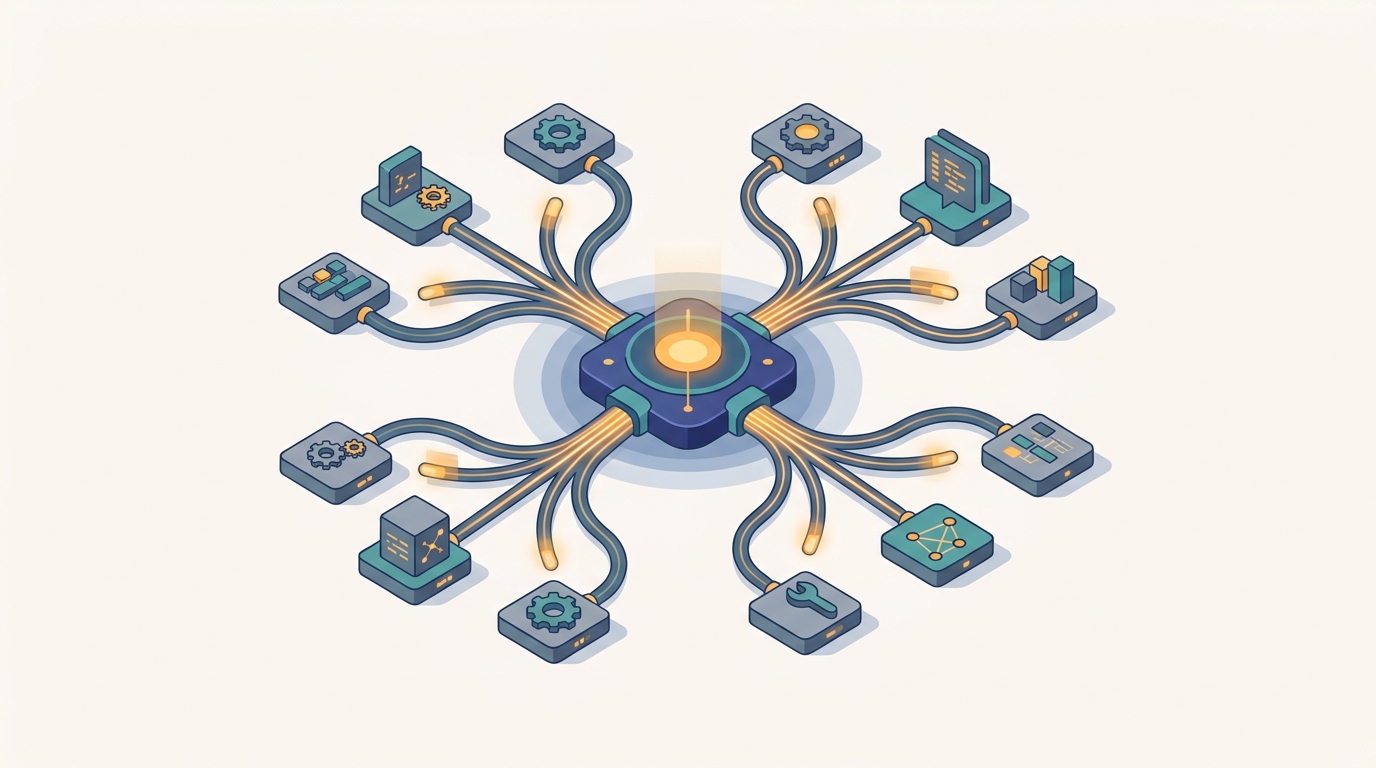
"I am the planner. I decomposed the task, dispatched it to three executors, and waited. Two came back brilliant, one hallucinated a tool that does not exist, and now I must decide whether the team succeeded. Coordination, it turns out, was the easy part."
A Planner Agent Awaiting Its Quorum
Chapter Overview
This is the synthesis chapter of Part VI, and its subject is what happens when the multi-agent ideas built across the part are applied to agents that are themselves large language models. Where Chapter 31 showed that simple agents need no coordinator to act as one, this chapter asks the opposite question: what coordination, what protocols, and what failure modes return when each agent is individually powerful, the communication channel is open-ended natural language, and every message is a billable, latency-bound, sometimes-failing network call. The answer is that the entire distributed-systems toolkit of this book comes back into play. The ten sections develop that answer in order, moving from the single agent as a component, through the structures and workflows that assemble agents into teams, into the protocols and shared state that let them interoperate, and out to the orchestration engines, evaluation, and economics that decide whether a multi-agent system works in production.
Read in order, the ten sections take you from "a language model can call a tool" to a working understanding of how to compose, run, evaluate, and afford a fleet of reasoning agents: frame the agent as a component, give it tools, organize it into planner and executor roles, run those roles as distributed workflows, sharpen their answers through debate and reflection, wire them together with interoperable protocols, let them share distributed memory, schedule and recover them on an orchestration engine, measure whether the system actually works, and account for what it costs to keep running. The argument carries forward the multi-agent foundations of Chapter 29, whose consensus and coordination return here as debate and orchestration, and the distributed serving substrate of Chapter 24, whose served models are the very agents this chapter composes. As the final chapter of Part VI, it gathers the part's recurring question, how independent pieces act as one, and answers it for the most capable and most expensive agents in the book, then hands the thread to the infrastructure that runs them all.
Prerequisites
This chapter sits at the meeting point of two earlier threads and assumes both. From Chapter 29: Multi-Agent Systems the reader should carry the engineering frame of a society of autonomous agents acting in a shared environment, together with the treatment of coordination and consensus, because the planner-executor structures of Section 32.3 and the debate of Section 32.5 are exactly those ideas applied to language-model agents, and the multi-agent failure modes named there return when the agents are expensive and the channel is natural language. From Chapter 24: Distributed LLM Serving the reader should carry a working picture of how a large language model is actually served across machines: batching, the KV cache, request scheduling, and the latency and throughput economics of a model endpoint. Every agent in this chapter is a client of exactly such an endpoint, and the cost, latency, and reliability concerns of Section 32.10 are those serving economics multiplied across many agents and many turns. The reader is also assumed comfortable with the distributed-systems vocabulary of the rest of the book, remote procedure calls, retries and timeouts, shared state and staleness, and workflow scheduling, since the chapter's whole argument is that orchestrating language-model agents is a distributed-systems problem in this vocabulary. No prior experience with any specific agent framework is required; Sections 32.1 and 32.2 build the agent abstraction from the ground up before any team is assembled on top of it.
Learning Objectives
- Explain why a multi-agent large language model system is a distributed system, and map agentic constructs (tool calls, planner dispatch, debate, shared memory, the orchestration engine) onto their classical distributed-systems counterparts (remote procedure calls, coordinator-worker fan-out, consensus, shared state, workflow scheduling).
- Describe the LLM agent as a distributed component and implement tool use through function calling, reasoning about the agent's loop of observe, decide, act, and observe again across a network boundary.
- Design planner-executor and role-specialized agent teams, and run them as parallel and distributed workflows, reasoning about decomposition, fan-out, partial failure, and stragglers.
- Apply debate, critique, and reflection patterns across agents to improve a team's output, and relate this convergence to the distributed consensus of Chapter 29.
- Explain the role of agent communication protocols (the Model Context Protocol and Agent2Agent) as a distributed message and capability fabric, and explain how shared state and distributed memory let agents coordinate over time.
- Characterize the distributed orchestration engines that schedule, retry, and recover agent graphs, and the trade-offs between graph-based, event-driven, and conversational orchestration.
- Evaluate distributed agentic systems on open-ended, stochastic tasks, and reason about the cost, latency, and reliability of running agent fleets at production scale.
Chapter Roadmap
- 32.1 LLM Agents as Distributed Components Frames the large language model agent as a distributed component with an observe-decide-act loop, and establishes the central claim that composing such agents is a distributed-systems problem.
- 32.2 Tool Use and Function Calling Gives the agent its reach into the world through function calling, treating each tool invocation as a remote procedure call across a process or network boundary with its own latency and failure modes.
- 32.3 Planner-Executor and Role-Specialized Agents Turns one agent into a team by separating planning from execution and assigning specialized roles, the coordinator-worker pattern rendered in natural language.
- 32.4 Parallel and Distributed Multi-Agent Workflows Runs agent teams as parallel and distributed workflows, confronting decomposition, fan-out, partial failure, and stragglers when many agents work at once.
- 32.5 Debate, Critique, and Reflection Across Agents Develops the patterns by which agents improve each other's output, debating, critiquing, and reflecting their way to an answer better than any single agent's, a consensus reached over language.
- 32.6 Agent Communication Protocols (MCP and A2A) Introduces the Model Context Protocol and the Agent2Agent protocol as the distributed message and capability fabric that lets agents and tools interoperate across vendors and processes.
- 32.7 Shared State and Distributed Memory Builds the shared state and distributed memory that a team of agents reads and writes over time, with the same consistency and staleness questions as any distributed store.
- 32.8 Distributed Orchestration Engines Studies the engines that schedule, retry, and recover agent graphs, comparing graph-based, event-driven, and conversational orchestration as workflow schedulers for agents.
- 32.9 Evaluating Distributed Agentic Systems Tackles the hard problem of judging open-ended, stochastic, multi-step agentic systems, from task-completion benchmarks to trajectory and cost-aware evaluation.
- 32.10 Cost, Latency, and Reliability at Scale Closes the chapter with the economics of running agent fleets in production: the cost of many model calls, the latency of multi-turn coordination, and the reliability engineering that keeps the system standing.
What's Next?
This chapter closed Part VI by carrying its entire lesson about coordination, consensus, and failure into the era of large language model agents, and by insisting on a single unifying view: a multi-agent LLM system is a distributed system, so orchestrating it is a distributed-systems discipline. The ten sections built that discipline from the single agent and its tools, through planner-executor teams and distributed workflows, debate and reflection, communication protocols and shared memory, orchestration engines, and finally evaluation and the cost-latency-reliability economics that decide whether any of it survives in production. With this chapter, Part VI is complete: the part traveled from distributed artificial intelligence and game-theoretic foundations, through multi-agent systems and multi-agent reinforcement learning, into swarm intelligence, and now to the orchestration of reasoning agents, a full arc of how independent pieces act as one. Chapter 33: Cluster Infrastructure and Scheduling opens Part VII and turns from what runs to what it runs on. Every system in this book so far, every parallel training job, every served model, every agent fleet, ultimately lands on a cluster that must place work on machines, share resources fairly, recover from node failures, and keep utilization high. The next chapter builds that substrate. Read Chapter 33 next, and see the infrastructure beneath everything you have learned to distribute.
Bibliography & Further Reading
Agents, Reasoning, and Tool Use
Yao, S., Zhao, J., Yu, D., Du, N., Shafran, I., Narasimhan, K., Cao, Y. "ReAct: Synergizing Reasoning and Acting in Language Models." arXiv:2210.03629, 2022. arxiv.org
The paper that interleaved chain-of-thought reasoning with tool actions in a single loop, the canonical reference for the observe-decide-act agent of Sections 32.1 and 32.2.
Shinn, N., Cassano, F., Berman, E., Gopinath, A., Narasimhan, K., Yao, S. "Reflexion: Language Agents with Verbal Reinforcement Learning." arXiv:2303.11366, 2023. arxiv.org
The method by which an agent reflects on its own failures in natural language and retries, the foundation of the reflection pattern in Section 32.5.
Multi-Agent Teams and Frameworks
Wu, Q., Bansal, G., Zhang, J., Wu, Y., Li, B., Zhu, E., Jiang, L., Zhang, X., Zhang, S., Liu, J., Awadallah, A. H., White, R. W., Burger, D., Wang, C. "AutoGen: Enabling Next-Gen LLM Applications via Multi-Agent Conversation." arXiv:2308.08155, 2023. arxiv.org
The conversational multi-agent framework whose configurable agents and group chat motivate the orchestration patterns of Sections 32.3 and 32.8.
Hong, S., Zheng, X., Chen, J., Cheng, Y., Wang, J., Zhang, C., Wang, Z., Yau, S. K. S., Lin, Z., Zhou, L., Ran, C., Xiao, L., Wu, C., Schmidhuber, J. "MetaGPT: Meta Programming for a Multi-Agent Collaborative Framework." arXiv:2308.00352, 2023. arxiv.org
The framework that encodes standardized operating procedures into role-specialized agents, a direct model for the role assignment of Section 32.3.
Qian, C., Liu, W., Liu, H., Chen, N., Dang, Y., Li, J., Yang, C., Chen, W., Su, Y., Cong, X., Xu, J., Li, D., Liu, Z., Sun, M. "ChatDev: Communicative Agents for Software Development." arXiv:2307.07924, 2023. arxiv.org
A virtual software company of role-playing agents that communicate to build software, a concrete instance of the planner-executor and parallel-workflow patterns of Sections 32.3 and 32.4.
Debate, Critique, and Collaboration
Du, Y., Li, S., Torralba, A., Tenenbaum, J. B., Mordatch, I. "Improving Factuality and Reasoning in Language Models through Multiagent Debate." arXiv:2305.14325, 2023. arxiv.org
The study showing that multiple agents debating to a shared answer improve factuality and reasoning, the empirical backbone of the debate treatment in Section 32.5.
Park, J. S., O'Brien, J. C., Cai, C. J., Morris, M. R., Liang, P., Bernstein, M. S. "Generative Agents: Interactive Simulacra of Human Behavior." arXiv:2304.03442, 2023. arxiv.org
The simulated society of memory-driven agents whose reflection-and-memory architecture informs the shared-memory discussion of Section 32.7.
Communication Protocols
Anthropic. "Model Context Protocol (MCP)." Specification and documentation, 2024. modelcontextprotocol.io
The open protocol that standardizes how agents connect to tools and data sources, the message fabric at the center of Section 32.6.
Google. "Agent2Agent (A2A) Protocol." Project documentation, 2025. a2a-protocol.org
The open protocol for agent-to-agent interoperability across vendors and frameworks, the peer-communication counterpart to MCP in Section 32.6.
Distributed Memory
Packer, C., Wooders, S., Lin, K., Fang, V., Patil, S. G., Stoica, I., Gonzalez, J. E. "MemGPT: Towards LLMs as Operating Systems." arXiv:2310.08560, 2023. arxiv.org
The virtual-context-management approach that treats memory as a paged hierarchy an agent manages itself, a model for the distributed memory of Section 32.7.
Orchestration Tools
LangChain. "LangGraph: Building Stateful, Multi-Actor Applications with LLMs." Documentation, 2024. langchain-ai.github.io
The graph-based orchestration library that models agent workflows as stateful graphs with checkpointing and recovery, a working instance of the engines in Section 32.8.
Failure Taxonomies and Reliability
Cemri, M., Han, S., Yang, K., Gu, J., Stoica, I., Goldberg, K., Parameswaran, A. "Why Do Multi-Agent LLM Systems Fail?" arXiv:2503.13657, 2025. arxiv.org
The MAST study: analysis of failures across seven agent frameworks and 150 tasks, identifying 14 failure modes in four categories (specification, inter-agent misalignment, task verification, infrastructure). Inter-agent misalignment, in which one agent reports success with an incorrect output and the error propagates silently, accounted for 42 percent of all observed failures. The taxonomy and its tracing implications are developed in Section 32.9.
Evaluation and Benchmarks
Jimenez, C. E., Yang, J., Wettig, A., Yao, S., Pei, K., Press, O., Narasimhan, K. "SWE-bench: Can Language Models Resolve Real-World GitHub Issues?" arXiv:2310.06770, 2023. arxiv.org
The benchmark of real software-engineering tasks that has become a standard yardstick for capable coding agents, central to the evaluation methods of Section 32.9.
Mialon, G., Fourrier, C., Swift, C., Wolf, T., LeCun, Y., Scialom, T. "GAIA: A Benchmark for General AI Assistants." arXiv:2311.12983, 2023. arxiv.org
A benchmark of multi-step, tool-using assistant tasks that are easy for humans and hard for agents, a probe of the open-ended evaluation challenge of Section 32.9.