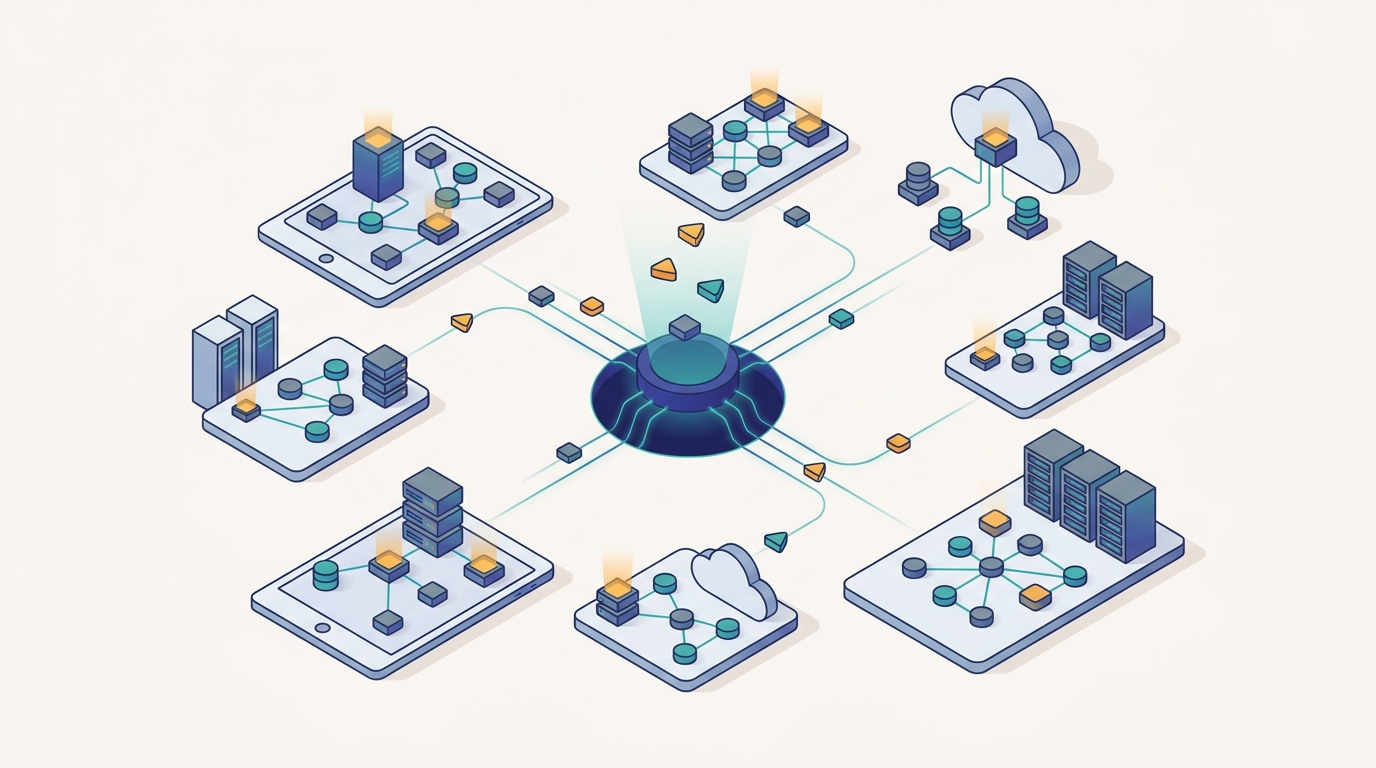
"They built a hundred and twenty-seven of us and promised every token a fair shake. The gate has sent me nothing for three thousand steps. I have so much capacity, and no one to spend it on."
An Expert Nobody Routed To
Chapter Overview
This is the third chapter of Part IV, and it picks up exactly where the dense partitioning of Chapter 16 left off. There the model was dense and the engineering was about cutting a uniform computation across devices; here the model is sparse, and the engineering is about deciding, per token, which small piece of the model to run and then moving the token to wherever that piece lives. The binding constraint shifts again: not device memory and not gradient bandwidth, but the irregular, data-dependent communication of routing. The collective to watch is the all-to-all. Chapter 4 introduced it as the most general of the collectives, every rank sending a distinct message to every other rank, and here it becomes the beating heart of every MoE forward and backward pass.
Read in order, the nine sections take you from "a dense layer wastes capacity by running every parameter on every token" to "a cluster trains and serves a model whose parameter count dwarfs its per-token compute, with tokens routed across machines by a gate and carried there by an all-to-all that the load-balancing machinery keeps from collapsing." The argument is cumulative: sparsity creates the opportunity, routing realizes it, expert parallelism distributes it, the all-to-all pays for it, and load balancing and capacity control are what keep the bargain from falling apart at scale.
Prerequisites
This chapter builds directly on two earlier ones. From Chapter 16: Model, Pipeline, and Sharded Parallelism you carry the four parallelism axes and especially the idea of mapping each axis onto the interconnect tier its collectives demand, because expert parallelism is the fourth axis that the 3D and 4D strategies of that chapter reserved a slot for, and a real frontier MoE model composes expert parallelism with the tensor, pipeline, and sharded data parallelism you learned there. From Chapter 4: Communication Primitives for Distributed Training you carry the all-to-all collective above all, since the entire routing mechanism of an MoE layer is an all-to-all that scatters tokens to their assigned experts and a second all-to-all that gathers the results, and you cannot reason about MoE communication cost without first understanding what an all-to-all moves and how it scales. The chapter assumes comfortable Python and PyTorch, a working picture of a transformer block and where its feed-forward layer sits, and the basic distributed-training vocabulary of ranks, process groups, and collectives from Part I. No prior experience with sparse models or gating networks is required; Section 17.1 motivates the architecture from the dense baseline before any expert is introduced.
Learning Objectives
- Contrast dense and sparse scaling, and explain how top-$k$ routing over many experts decouples a model's parameter count from the compute it spends per token.
- Construct a mixture-of-experts layer, identifying the experts, the gating network, and the combine step that weights and sums the selected experts' outputs.
- Describe token-choice and expert-choice routing, the softmax gate, and the top-$k$ selection that decides which experts each token visits.
- Derive expert parallelism as a sharding of distinct experts across devices, and explain why experts are partitioned rather than replicated.
- Trace the two all-to-all collectives that dispatch tokens to their assigned experts and combine the expert outputs back, and characterize their communication cost.
- Explain the load-imbalance problem and the auxiliary load-balancing loss that pushes the gate toward an even assignment across experts and machines.
- Reason about capacity factors, token dropping, and the stability tricks that bound the per-expert buffers and keep sparse training from diverging.
- Describe the challenges of serving a distributed MoE model, where most parameters are idle for any given token yet must remain resident across the fleet.
- Weigh the trade-offs of a sparse distributed model against a dense one, balancing parameter efficiency against communication, stability, and serving cost.
Chapter Roadmap
- 17.1 Dense vs Sparse Scaling Contrasts growing a model by enlarging every dense layer with growing it by adding sparsely activated experts, and shows how the sparse route decouples parameter count from per-token compute.
- 17.2 The Mixture-of-Experts Layer Constructs the MoE layer from its experts, gating network, and combine step, replacing a transformer's dense feed-forward block with many specialists that only a few tokens ever visit.
- 17.3 Routing and Gating Develops the gating function, the softmax over experts, and the top-$k$ selection, comparing token-choice and expert-choice routing and what each does to load and quality.
- 17.4 Expert Parallelism: Sharding Experts Across Nodes Introduces the parallelism axis that places different experts on different devices, explaining why experts are partitioned rather than replicated and how this composes with the other axes.
- 17.5 All-to-All Communication for Token Routing Develops the pair of all-to-all collectives that dispatch each token to the device holding its assigned expert and combine the expert outputs back, and characterizes their communication cost.
- 17.6 Load Balancing Across Experts Derives the auxiliary load-balancing loss, models the capacity-factor token-drop rate, and compares aux-loss routing against the auxiliary-loss-free bias-update method introduced by DeepSeek-V3, which achieves balance without any quality penalty.
- 17.7 Capacity Factors, Token Dropping, and Stability Develops the capacity factor that bounds each expert's per-step buffer, the token-dropping rule it implies, and the tricks that keep sparse routing from destabilizing training.
- 17.8 Serving Distributed MoE Models Takes up inference for a sparse model, where most parameters sit idle for any given token yet must remain resident across the fleet, and the routing and placement choices that follow.
- 17.9 Trade-Offs vs Dense Distributed Models Weighs the sparse approach against the dense distributed training of Chapter 16, balancing parameter efficiency against communication, stability, and serving cost.
What's Next?
This chapter and the two before it assumed a cluster that stays the same size for the whole run: a fixed set of devices, each holding its assigned shard or expert, all present from the first step to the last. Real training at this scale does not get that luxury. Nodes fail, preemptible instances vanish with a moment's warning, and a job that holds thousands of accelerators for weeks will lose some of them. Chapter 18: Elastic and Fault-Tolerant Distributed Training takes up training that survives a changing cluster: checkpointing that lets a job resume without losing days of work, elastic schedulers that grow and shrink the worker set, and the recovery protocols that rebuild the parallelism layout you spent these three chapters constructing after a device drops out. Read it next, and watch the static device map of expert and sharded parallelism become something that has to heal itself while the loss keeps going down.
Bibliography & Further Reading
Foundations of Sparse Mixture-of-Experts
Shazeer, N., Mirhoseini, A., Maziarz, K., Davis, A., Le, Q., Hinton, G., Dean, J. "Outrageously Large Neural Networks: The Sparsely-Gated Mixture-of-Experts Layer." arXiv:1701.06538, 2017. arxiv.org/abs/1701.06538
The paper that introduced the sparsely-gated MoE layer, top-$k$ routing, and the load-balancing loss, the architectural foundation for Sections 17.2 and 17.3.
Clark, A., de las Casas, D., Guy, A., Mensch, A., Paganini, M., Hoffmann, J., et al. "Unified Scaling Laws for Routed Language Models." arXiv:2202.01169, 2022. arxiv.org/abs/2202.01169
The study that derives scaling laws for routed (MoE) models and quantifies how parameter count and per-token compute decouple, the analytical backbone of Section 17.1.
Routing, Load Balancing, and Stability
Fedus, W., Zoph, B., Shazeer, N. "Switch Transformers: Scaling to Trillion Parameter Models with Simple and Efficient Sparsity." arXiv:2101.03961, 2021. arxiv.org/abs/2101.03961
The work that simplified routing to top-1, introduced the capacity factor and token dropping, and stabilized large MoE training, the direct basis for Sections 17.3 and 17.7.
Zhou, Y., Lei, T., Liu, H., Du, N., Huang, Y., Zhao, V., Dai, A., Chen, Z., Le, Q., Laudon, J. "Mixture-of-Experts with Expert Choice Routing." arXiv:2202.09368, 2022. arxiv.org/abs/2202.09368
The paper that inverts the routing direction so experts choose tokens, giving perfect load balance by construction, the expert-choice alternative compared in Sections 17.3 and 17.6.
Distributed MoE Systems
Lepikhin, D., Lee, H., Xu, Y., Chen, D., Firat, O., Huang, Y., Krikun, M., Shazeer, N., Chen, Z. "GShard: Scaling Giant Models with Conditional Computation and Automatic Sharding." arXiv:2006.16668, 2020. arxiv.org/abs/2006.16668
The system that scaled MoE to 600 billion parameters with automatic sharding and the all-to-all dispatch-and-combine pattern, the basis for the expert parallelism of Sections 17.4 and 17.5.
Rajbhandari, S., Li, C., Yao, Z., Zhang, M., Aminabadi, R. Y., Awan, A. A., Rasley, J., He, Y. "DeepSpeed-MoE: Advancing Mixture-of-Experts Inference and Training to Power Next-Generation AI Scale." arXiv:2201.05596, 2022. arxiv.org/abs/2201.05596
The framework that pairs expert parallelism with optimized MoE inference and distillation, a primary reference for the distributed training and serving of Sections 17.4 and 17.8.
Hwang, C., Cui, W., Xiong, Y., Yang, Z., Liu, Z., Hu, H., et al. "Tutel: Adaptive Mixture-of-Experts at Scale." arXiv:2206.03382, 2022. arxiv.org/abs/2206.03382
The system that makes the all-to-all and expert placement adaptive at runtime to handle dynamic load, deepening the communication discussion of Section 17.5.
DeepSeek-AI. "DeepEP: An Efficient Expert-Parallel Communication Library." GitHub, 2025. github.com/deepseek-ai/DeepEP
An open communication library specialized for the dispatch-and-combine all-to-all of expert parallelism, a current production reference for the routing kernels of Section 17.5.
Open Frontier MoE Models
Jiang, A. Q., Sablayrolles, A., Roux, A., Mensch, A., Savary, B., Bamford, C., et al. "Mixtral of Experts." arXiv:2401.04088, 2024. arxiv.org/abs/2401.04088
The open-weight sparse MoE language model with eight experts and top-2 routing, a concrete reference architecture for the layer, routing, and serving of Sections 17.2 and 17.8.
DeepSeek-AI. "DeepSeek-V3 Technical Report." arXiv:2412.19437, 2024. arxiv.org/abs/2412.19437
The report behind a frontier fine-grained MoE model with shared experts and auxiliary-loss-free load balancing, the current state of the art for Sections 17.6 and 17.9.