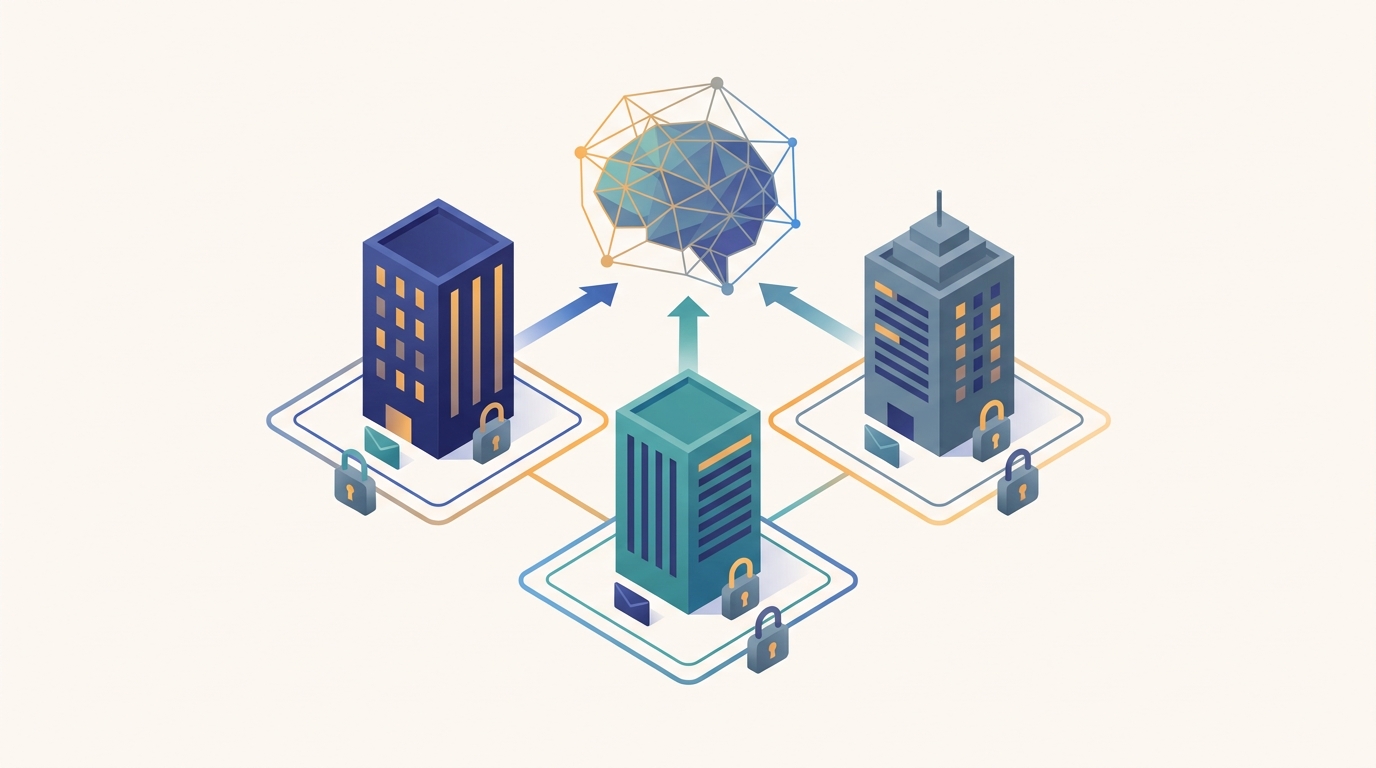
"I have learned from a hundred thousand patients I will never see, in twelve hospitals I have never entered. They send me their gradients and keep their records. I am wiser for it, and I could not name a single soul who taught me."
A Global Model That Has Never Met Its Data
Chapter Overview
Part VIII assembles the book into end-to-end systems, and this is its second and most constrained assembly: a clinical model trained across many hospitals whose data legally cannot be pooled. In the previous chapter the corpus was the open web, public and copyable, and the only real adversary was scale: the system could crawl, deduplicate, and centralize the data freely, then distribute the compute to keep up. Here the binding constraint is the opposite. A patient record cannot be copied to a shared cluster, cannot be sent across an institutional boundary, and in many jurisdictions cannot leave the hospital at all. The data never moves. What moves instead is the model, and the intelligence it carries. This chapter takes the federated and decentralized learning of Chapter 14, the differential privacy and secure aggregation and governance of Chapter 35, and the federated edge learning of Section 34.6, and composes them into a single system that learns one model from data that stays put.
The final stretch makes the system responsible and hands it to the reader. Section 37.8 treats safety and responsibility as first-class engineering: fairness across sites and subgroups, auditability of a model no one can fully inspect, and the human-in-the-loop and governance that a clinical deployment demands. Section 37.9 closes with a project extension that hands the reader the levers, adding sites, tightening the privacy budget, hardening the aggregation against a malicious participant, so the case study becomes a system to build and defend rather than only to read. Read in order, the nine sections make the argument that the rest of Part VIII repeats in other domains: a real distributed AI system is shaped by its binding constraint, and when that constraint is that the data cannot move, federation, privacy, and safety stop being features and become the architecture.
Prerequisites
This chapter is a synthesis, so it assumes the parts it composes rather than reteaching them. From Chapter 14 it assumes the federated learning model itself, the FedAvg round of local training and central averaging, gossip, and the decentralized setting where data never leaves its machine, which is the substrate the whole chapter builds on. From Chapter 35 it assumes differential privacy, secure aggregation, Byzantine-robust aggregation, and the governance vocabulary that Sections 37.3 and 37.6 turn into a clinical privacy stack. From Section 34.6 it assumes federated edge learning, the practical shape of training across many resource-constrained, intermittently available participants that each hospital resembles. From Chapter 5 it assumes the evaluation methodology that Section 37.7 applies per site, and from Chapter 26 it assumes the MLOps practices, monitoring, drift detection, and lifecycle management, that a fleet of clinical deployments requires. A reader comfortable with those threads can read this chapter as the place where federation, privacy, and safety finally run together on one regulated system.
Learning Objectives
- Recognize the no-data-movement constraint as the design driver of a clinical system, and explain why a problem that forbids centralization makes federation the architecture rather than an option.
- Reconcile heterogeneous multi-hospital data through a common data model, letting sites share a schema and a vocabulary without sharing a single patient record.
- State clinical privacy constraints precisely and reason about what a model update can leak, then bound that leakage with differential privacy and secure aggregation.
- Stand up a federated training loop across institutions and diagnose why non-identical data distributions break naive averaging, applying heterogeneity-aware methods such as FedProx and SCAFFOLD.
- Build a secure-aggregation step so the server learns only the masked sum of updates, and compose cryptographic masking with a differential-privacy budget into one aggregation path.
- Monitor a federated model per site for drift and silent degradation, and treat fairness, auditability, and human oversight as engineering requirements that a clinical deployment must meet.
If you keep one thing from this chapter, keep this: when the data cannot move, you move the model instead, and every hard problem that follows, privacy leakage, site heterogeneity, and clinical safety, is the price of learning from data you are never allowed to see. The previous chapter distributed a system to reach scale, because the easy move, centralize everything, was available and only expensive. This chapter distributes a system to respect a constraint, because the easy move is forbidden by law and ethics. That single difference reshapes everything downstream. The model update that travels in place of the data can leak that data, so secure aggregation and differential privacy bound what the server and any eavesdropper can learn. The hospitals that hold the data are not identical, so heterogeneity-aware optimization keeps their conflicting updates from tearing the global model apart. The model is deployed into many populations at once and a wrong answer reaches a patient, so per-site monitoring, fairness, and human oversight are not polish but structure. Read forward, the chapter walks that system from the clinical problem to the deployed, monitored, governed model. Read as a question, it is the checklist you carry into any privacy-constrained system: where does the data refuse to move, what does moving the model in its place leak, and does the safety case hold at every site? The roadmap below walks the nine sections that build that system end to end.
Chapter Roadmap
- 37.1 Problem Definition The clinical prediction task, the participating institutions, and the legal and ethical constraints that make centralizing patient data impossible and name federation as the only viable architecture.
- 37.2 Multi-Hospital Data The formats, schemas, and case mix that differ from one institution to the next, and the common data model that lets sites speak one vocabulary without sharing a single patient row.
- 37.3 Privacy Constraints What a patient is owed and what the law requires, stated precisely, alongside what an attacker could reconstruct from a model update if nothing were done to stop it.
- 37.4 Federated Learning Setup The rounds of local training and central aggregation that turn many private datasets into one shared model, moving model updates instead of data and keeping every record in place.
- 37.5 Data Heterogeneity Why non-identical case mix, label distributions, and equipment across sites make naive averaging diverge, and the heterogeneity-aware methods such as FedProx and SCAFFOLD that hold the global model together.
- 37.6 Secure Aggregation Cryptographic masking and differential privacy layered onto the aggregation step so the server learns only the summed update and never any single hospital's contribution.
- 37.7 Monitoring and Drift Across Sites Watching a model deployed into many distinct populations at once for the distribution shift and silent degradation that no single global metric reveals, site by site.
- 37.8 Safety and Responsibility Fairness across sites and subgroups, auditability of a model no one can fully inspect, and the human-in-the-loop and governance that a clinical deployment treats as first-class engineering.
- 37.9 Project Extension The levers handed to the reader: adding sites, tightening the privacy budget, and hardening aggregation against a malicious participant, turning the case study from something to read into something to build and defend.
What's Next?
This chapter built a distributed AI system around the hardest possible data constraint: the records cannot move, so the model must, and privacy and safety dominate every choice. Chapter 38: Distributed Recommendation at Scale swings the pendulum back toward throughput. The next case study drops the no-data-movement constraint and trades it for a volume one: billions of interactions, embedding tables too large for any one machine, and a latency budget measured in milliseconds per request. Where this chapter spent its engineering on keeping data still and updates private, the next spends it on sharded embeddings, parameter servers at industrial scale, and high-throughput personalization that must answer instantly. The sharded embedding tables of Chapter 11 return there as the heart of a recommender rather than a building block. Read it next to see the same composition discipline tested against a constraint that is the inverse of this one: not privacy, but scale and speed.
Bibliography & Further Reading
Federated Algorithms
McMahan, H. B., Moore, E., Ramage, D., Hampson, S., Aguera y Arcas, B. "Communication-Efficient Learning of Deep Networks from Decentralized Data (FedAvg)." AISTATS 2017. arXiv:1602.05629
The paper that defined federated averaging: clients train locally, the server averages model updates, and the data never leaves the device. The training loop the entire chapter builds on in Section 37.4.
Li, T., Sahu, A. K., Zaheer, M., Sanjabi, M., Talwalkar, A., Smith, V. "Federated Optimization in Heterogeneous Networks (FedProx)." MLSys 2020. arXiv:1812.06127
Adds a proximal term that keeps local updates from drifting too far when client data is non-identical; the first of the heterogeneity-aware methods that stabilize the global model in Section 37.5.
Karimireddy, S. P., Kale, S., Mohri, M., Reddi, S. J., Stich, S. U., Suresh, A. T. "SCAFFOLD: Stochastic Controlled Averaging for Federated Learning." ICML 2020. arXiv:1910.06378
Uses control variates to correct the client drift that heterogeneous data induces, sharpening convergence where FedAvg stalls; the second pillar of the heterogeneity treatment in Section 37.5.
Privacy & Security
Bonawitz, K., Ivanov, V., Kreuter, B., et al. "Practical Secure Aggregation for Privacy-Preserving Machine Learning." ACM CCS 2017. eprint.iacr.org/2017/281
The protocol that lets a server compute the sum of client updates without seeing any single one, tolerant of dropouts; the cryptographic masking at the core of the secure aggregation in Section 37.6.
Abadi, M., Chu, A., Goodfellow, I., et al. "Deep Learning with Differential Privacy (DP-SGD)." ACM CCS 2016. arXiv:1607.00133
Introduces gradient clipping, calibrated noise, and the moments accountant that make a privacy budget trainable; the differential-privacy layer bounding what a model update can leak in Sections 37.3 and 37.6.
Kaissis, G. A., Makowski, M. R., Ruckert, D., Braren, R. F. "Secure, Privacy-Preserving and Federated Machine Learning in Medical Imaging." Nature Machine Intelligence 2, 2020. nature.com
A clinical-imaging synthesis of federation, differential privacy, and secure computation; the survey that frames why all three are needed together, exactly the stack this chapter assembles.
Medical Applications
Sheller, M. J., Edwards, B., Reina, G. A., et al. "Federated Learning in Medicine: Facilitating Multi-Institutional Collaborations Without Sharing Patient Data." Nature Scientific Reports 10, 2020. nature.com
Shows a federated model trained across institutions matching one trained on pooled data, without the data ever being pooled; the empirical case that the no-data-movement constraint of Section 37.1 is not a quality penalty.
Rieke, N., Hancox, J., Li, W., et al. "The Future of Digital Health with Federated Learning." npj Digital Medicine 3, 2020. nature.com
The reference roadmap for clinical federated learning: governance, heterogeneity, privacy, and deployment laid out as the open challenges this chapter's later sections engineer against.
Dayan, I., Roth, H. R., Zhong, A., et al. "Federated Learning for Predicting Clinical Outcomes in Patients with COVID-19 (EXAM)." Nature Medicine 27, 2021. nature.com
A twenty-site federated model predicting oxygen needs from emergency-department data, deployed across continents without sharing records; the large-scale proof that the system this chapter describes is real.
Hripcsak, G., Duke, J. D., Shah, N. H., et al. "Observational Health Data Sciences and Informatics (OHDSI): The OMOP Common Data Model." Studies in Health Technology and Informatics 216, 2015. pubmed.ncbi.nlm.nih.gov
The common data model that maps heterogeneous hospital records onto one shared schema; the vocabulary that lets sites in Section 37.2 align their data without ever exchanging a patient row.