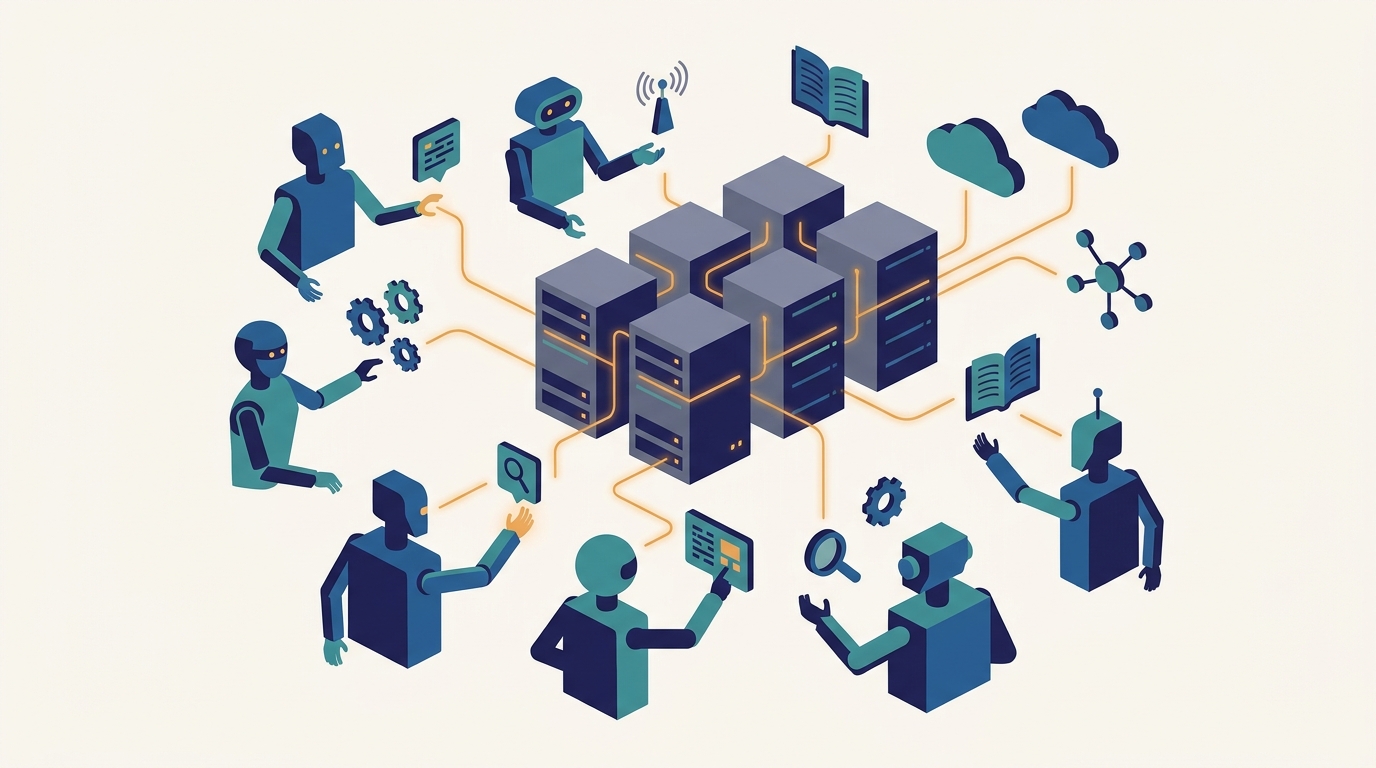
"The user asked one question. I read forty documents I was allowed to see, called three tools, spun up two sub-agents, and queued behind nine hundred other requests for a slice of a model that lives on someone else's GPU. They are still waiting for one sentence. I am, somehow, a distributed system."
An Agent That Discovered It Was a Cluster
Chapter Overview
Part VIII assembles the book into end-to-end systems, and this is its fifth and most integrative assembly, the case study that asks every earlier part to run at once. The four case studies before it each isolated one binding constraint: a corpus too large to retrieve from one index, a model too sensitive to centralize, a recommender too wide for one host, a swarm too physical to coordinate from a center. This one removes the isolation. A production agentic application, a research assistant over a company's documents, a customer-support agent with tools, a coding agent that reads a repository and acts on it, is distributed on every axis simultaneously because no single one of its jobs fits on one machine. The document corpus does not fit, so ingestion is a distributed data pipeline. The embedding and the index do not fit, so retrieval is sharded vector search. The reasoning is multi-step and calls out to tools and sub-agents, so control is distributed agent orchestration. And the model is shared by thousands of concurrent users, so generation rides a distributed serving fleet. The application is the place where all four meet, and the chapter is the discipline of making them meet within a budget.
Prerequisites
This chapter is the most integrative synthesis in the book, so it assumes the parts it composes rather than reteaching them. From Chapter 24 it assumes distributed LLM serving, the continuous batching, paged attention, and multi-replica fleet that Section 40.7 turns into the generation engine under every agent step. From Chapter 25 it assumes distributed retrieval and vector search, the sharded approximate-nearest-neighbor index that Section 40.4 queries under security-aware filtering. From Chapter 32 it assumes distributed agent orchestration, the planner, tool calls, and sub-agent coordination that Section 40.6 assembles into the agentic loop. From Chapter 36 it assumes the web-scale retrieval-augmented generation case study, the ingestion-to-grounding pipeline that Section 40.2 through Section 40.5 specialize to a single application's corpus. From Chapter 22 it assumes per-node inference efficiency, the quantization and KV-cache numbers that Section 40.7 and Section 40.8 multiply across the fleet to make a budget hold. From Chapter 26 it assumes MLOps for distributed AI, the deployment, monitoring, and evaluation discipline that Section 40.9 turns on the assembled agentic system. A reader comfortable with those threads can read this chapter as the place where retrieval, orchestration, serving, and operations finally run together as one application.
Learning Objectives
- Recognize a production LLM-powered agentic application as a distributed system of cooperating agents, tool services, and model replicas, and explain why ingestion, retrieval, reasoning, and serving each become a distribution problem the moment the corpus, the user count, or the model outgrows one machine.
- Build the data path of an agentic application: distributed document processing, embedding pipelines that run at corpus scale, and a sharded vector index queried under security-aware filtering that decides which passages a given user may retrieve.
- Assemble retrieval-augmented generation at scale, grounding many concurrent queries in retrieved evidence so that the answers stay correct and the cost stays bounded.
- Coordinate a multi-step agentic loop with distributed orchestration, a planner that calls tools and delegates to sub-agents across a network of services rather than a single model call.
- Serve the generation on a distributed model-serving fleet with vLLM, and control cost across that fleet by routing steps to right-sized models, caching what repeats, and capping the agentic loop.
- Evaluate a multi-step agentic application end to end, from retrieval metrics through LLM-as-a-judge to task success under a latency and cost budget, and reason about how to extend the system.
If you keep one thing from this chapter, keep this: an agentic application is a distributed system of cooperating agents, tool services, and model replicas that spans every axis of distribution at once, and its reasoning, retrieval, and serving each become distribution problems the instant the corpus, the user count, or the model stops fitting on one machine. The earlier case studies each pivoted on one binding constraint; this one pivots on the fact that an agentic product has all of them together. The corpus does not fit, so ingestion, embedding, and indexing are distributed data pipelines feeding a sharded vector index. The right passages depend on who is asking, so retrieval carries a security boundary, not just a similarity score. The reasoning is multi-step and reaches out to tools and sub-agents, so control is orchestration across a network of services rather than a single prompt. The model is shared by thousands of users, so generation rides a serving fleet whose throughput, governed by continuous batching and paged attention, sets the ceiling on how much an agent may think. And because every step costs tokens and milliseconds, the whole loop runs against a budget that forces cheap steps onto small models, caches what repeats, and caps runaway reasoning before it can spend the day. Read forward, the chapter walks that system from the agentic problem to the deployed, evaluated, budgeted application. Read as a question, it is the checklist you carry into any agentic product: where does the corpus live, who may retrieve what, how does the reasoning fan out across services, what fleet serves the tokens, and does the whole loop stay inside its latency and cost budget? The roadmap below walks the ten sections that build that application end to end.
Chapter Roadmap
- 40.1 Problem Definition The agentic task, the corpus that must be ingested, the security boundary that decides which passages a given user may retrieve, and the cost and latency budgets that rule out calling the largest model on every step.
- 40.2 Distributed Document Processing The ingestion pipeline that parses, chunks, and cleans a document corpus spread across many machines, the distributed data path that feeds everything the application later embeds and indexes.
- 40.3 Embedding Pipelines Turning the processed corpus into vectors at scale, the throughput-bound encoding stage that bridges document processing to search and sets the cost of building the index.
- 40.4 Sharded Vector Search The vector index partitioned across nodes and queried under security-aware filtering, the distributed retrieval of Chapter 25 specialized to a single application's corpus and access rules.
- 40.5 RAG at Scale Wiring the sharded index into the generation loop so that grounding many concurrent queries in retrieved evidence stays correct and affordable, the case-study payoff of Chapter 36 inside one application.
- 40.6 Distributed Agent Orchestration Applies disaggregated prefill-decode serving (Mooncake, OSDI 2025) to the agentic application stack: prefill fleet on high-FLOPs H100s, decode fleet on memory-bandwidth-optimised A10s, KV-cache RDMA transfer, and stateful scheduling to keep multi-turn conversation caches warm on the same decode instance.
- 40.7 Distributed Model Serving with vLLM Covers the agent interoperability protocol stack: MCP for tool and context access within a single agent; A2A for agent-to-agent delegation (donated to the Linux Foundation, August 2025); and the evaluation gap identified by MAST, where task-level benchmarks miss inter-agent communication failures.
- 40.8 Cost Control Across the Fleet Routing cheap steps to small models and hard steps to large ones, caching what repeats, and capping the agentic loop so a single runaway query cannot spend the day's budget.
- 40.9 Evaluation Measuring whether a multi-step agentic application is correct, grounded, and within budget, from retrieval metrics through LLM-as-a-judge to end-to-end task success.
- 40.10 Project Extension The levers handed to the reader: swapping the index, adding tools and sub-agents, tightening the security boundary, or changing the serving and routing policy, turning the case study into a system to build and defend.
What's Next?
This chapter assembled the book into one running application: an agentic system that ingests a corpus, retrieves under a security boundary, reasons across tools and sub-agents, and serves thousands of users from a model fleet, all inside a cost and latency budget. It is the last of the worked case studies, and with it the integrative survey of real distributed AI systems is complete. Chapter 41: Capstone Project Design turns the book from reading systems to building one of your own. Where the case studies handed you finished architectures to dissect, the capstone hands you the design space and asks you to choose: pick a problem, name the ceiling that forces it to distribute, select the axis that answers that ceiling, and defend the trade in communication and cost the choice commits you to. The six axes of Chapter 1 and the design-space checklist you met there return as the rubric for your own distributed AI system. Read it next to turn five case studies' worth of pattern recognition into a project you propose, build, and defend.
Bibliography & Further Reading
Agents & Tools
Yao, S., Zhao, J., Yu, D., et al. "ReAct: Synergizing Reasoning and Acting in Language Models." ICLR 2023. arXiv:2210.03629
Interleaves chain-of-thought reasoning with tool-calling actions so a model can plan, act, and observe in a loop; the reasoning-and-acting pattern at the core of the agentic orchestration in Section 40.6.
Schick, T., Dwivedi-Yu, J., Dessi, R., et al. "Toolformer: Language Models Can Teach Themselves to Use Tools." NeurIPS 2023. arXiv:2302.04761
Shows a model can learn when and how to call external tools (search, calculator, APIs) from self-supervised data; the grounding for the tool services that an agent step in Section 40.6 dispatches to.
Patil, S. G., Zhang, T., Wang, X., Gonzalez, J. E. "Gorilla: Large Language Model Connected with Massive APIs." NeurIPS 2024. arXiv:2305.15334
Trains a model to select and invoke the right API from a large, changing catalog; the tool-routing problem that scales when an agent in Section 40.6 has many services to choose from.
Shinn, N., Cassano, F., Gopinath, A., et al. "Reflexion: Language Agents with Verbal Reinforcement Learning." NeurIPS 2023. arXiv:2303.11366
Has an agent reflect on its own failed trajectories in natural language and retry better; the self-correction loop that makes the multi-step reasoning of Section 40.6 more robust without retraining.
Wu, Q., Bansal, G., Zhang, J., et al. "AutoGen: Enabling Next-Gen LLM Applications via Multi-Agent Conversation." 2023. arXiv:2308.08155
A framework for building applications from multiple conversing agents that delegate and coordinate; a concrete realization of the sub-agent orchestration that Section 40.6 distributes across services.
RAG & Serving
Lewis, P., Perez, E., Piktus, A., et al. "Retrieval-Augmented Generation for Knowledge-Intensive NLP Tasks." NeurIPS 2020. arXiv:2005.11401
The paper that named RAG, coupling a neural retriever to a generator so answers are grounded in retrieved passages; the foundation for the RAG-at-scale loop of Section 40.5.
Kwon, W., Li, Z., Zhuang, S., et al. "Efficient Memory Management for Large Language Model Serving with PagedAttention (vLLM)." SOSP 2023. arXiv:2309.06180
Introduces paged attention and continuous batching to pack the KV cache and raise serving throughput sharply; the engine of the distributed model-serving fleet in Section 40.7.
Khattab, O., Singhvi, A., Maheshwari, P., et al. "DSPy: Compiling Declarative Language Model Calls into Self-Improving Pipelines." ICLR 2024. arXiv:2310.03714
Treats a multi-step LLM pipeline as a program to be compiled and optimized rather than hand-prompted; the systematic way to build and tune the retrieval-and-reasoning chains of Section 40.5 and Section 40.6.
Evaluation & Protocols
Es, S., James, J., Espinosa-Anke, L., Schockaert, S. "RAGAS: Automated Evaluation of Retrieval Augmented Generation." 2023. arXiv:2309.15217
A reference-free framework that scores faithfulness, answer relevance, and context relevance for RAG systems; the retrieval-and-grounding metrics that anchor the evaluation of Section 40.9.
Zheng, L., Chiang, W.-L., Sheng, Y., et al. "Judging LLM-as-a-Judge with MT-Bench and Chatbot Arena." NeurIPS 2023. arXiv:2306.05685
Validates using a strong model as an automated judge of open-ended answers and surfaces its biases; the LLM-as-a-judge backbone of the end-to-end task evaluation in Section 40.9.
Anthropic. "Model Context Protocol (MCP)." 2024. modelcontextprotocol.io
An open protocol standardizing how agents connect to tools, data sources, and context servers; the interface discipline that lets the orchestrated tools and sub-agents of Section 40.6 compose across a network of services.