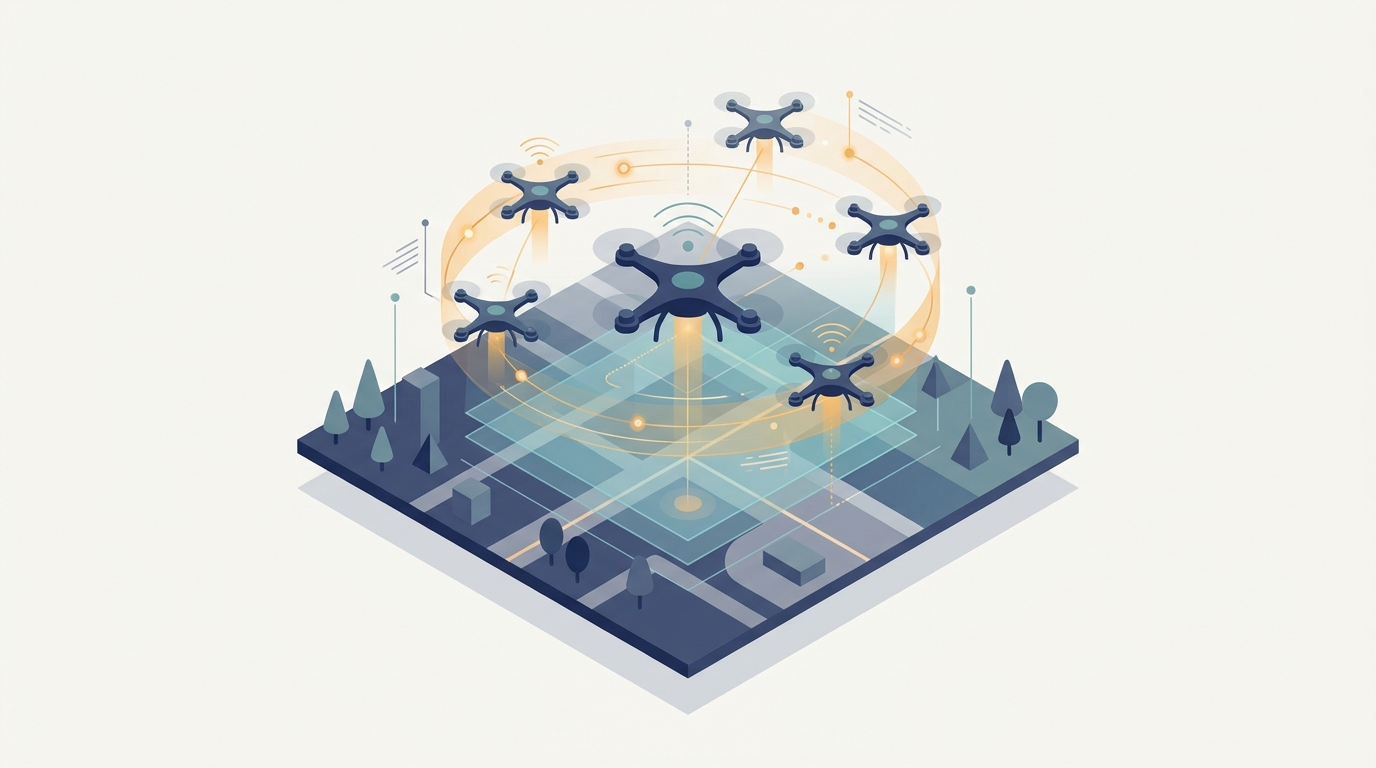
"I can see four of my neighbors, hear two more through static, and have lost the seventh entirely. The plan said we would vote. The plan did not say the seventh would fly into a wall. I am voting anyway, with whoever is left, in the next forty milliseconds."
A Drone Holding Formation on a Quorum of Whoever Replied
Chapter Overview
Part VIII assembles the book into end-to-end systems, and this is its fourth and most physical assembly. The first three case studies all ran in a data center, where distribution is a choice the engineer makes to get past a ceiling: too much data for one corpus, too much privacy risk to centralize, too large a model for one host. This one removes the choice. A swarm of drones surveying a disaster site, a fleet of warehouse robots, a team of agricultural rovers: these are distributed systems because the work is physically spread across space and there is no machine that could possibly do it alone. The cluster here is embodied and moving, each node carrying its own sensors, its own position, its own partial and slightly stale picture of where everyone else is, and the network between them is a radio whose reach is bounded and whose links come and go. That single fact, no reliable center and no shared clock, organizes the chapter the way "the model does not fit" organized the last one.
Prerequisites
This chapter is a synthesis, so it assumes the parts it composes rather than reteaching them. From Chapter 29 it assumes the multi-agent systems vocabulary of agents, interaction protocols, negotiation, and auctions that Section 39.2 and Section 39.3 turn into coordination and allocation for moving robots. From Chapter 30 it assumes multi-agent reinforcement learning, the centralized-training and decentralized-execution methods that Section 39.7 trains into swarm policies. From Chapter 31 it assumes swarm intelligence and collective behavior, the local-rule-to-global-pattern principle behind the flocking and formation control of Section 39.6. From Chapter 20 it assumes distributed reinforcement learning infrastructure, the actor-learner architecture that Section 39.7 and Section 39.8 scale across thousands of parallel simulated swarms. From Chapter 34 it assumes the distributed sensing of Section 34.5 and the on-device robotics of Section 34.8, the embodied edge that this whole chapter runs on. From Chapter 2 it assumes consensus, partition tolerance, and failure recovery, the agreement primitives that Section 39.2 and Section 39.9 specialize to a moving swarm. From Chapter 35 it assumes reliability and Byzantine-robust aggregation, the safety backbone of Section 39.9. A reader comfortable with those threads can read this chapter as the place where multi-agent coordination, swarm rules, distributed RL, and reliable agreement finally run together on a cluster that moves.
Learning Objectives
- Recognize an embodied, mobile swarm with no field coordinator as a distributed system, and explain why decentralization, lossy communication, and hard real-time safety are the design drivers rather than optimizations.
- Coordinate multiple robots on formation, role, and intent through decentralized consensus, with no central controller whose failure would take down the whole swarm.
- Allocate tasks across a robot fleet with market-style and consensus-based auctions that assign jobs without a central dispatcher and survive agents joining or dropping out.
- Design a swarm to operate under range-limited, lossy communication and network partitions, building shared situational awareness from local sensors plus whatever neighbors managed to send.
- Produce coherent collective motion, flocking, formation, and reciprocal collision avoidance, from purely local control laws, and train swarm policies with multi-agent reinforcement learning in massively parallel simulation.
- Transfer a simulation-trained policy onto hardware with domain randomization, and reason about safety and failure modes when an agent dies, a link partitions, or a message lies.
If you keep one thing from this chapter, keep this: when the cluster is embodied, mobile, and has no reliable center, every act of intelligence, coordinating, allocating, sensing, and controlling, must be done decentrally by agents that see only their own corner, and the hard parts are learned and proven in massively parallel simulation before they are trusted to hardware that a crash will not forgive. The previous case study partitioned a model because the parameters did not fit; this one partitions intelligence itself because the agents are physically scattered across space and joined by a radio that fails. That single fact reshapes everything downstream. No node can be in charge, so formation and intent are settled by consensus among whoever is reachable, and jobs are handed out by decentralized auctions rather than a dispatcher. The radio drops packets and partitions the swarm, so situational awareness is a local estimate stitched from neighbors rather than a shared map, and control laws produce coherent motion from purely local rules. The deadline is a collision, so collision avoidance and safety are reflexes inside the loop, not services behind it. And because a real swarm is too dangerous and too slow to learn on directly, the policy is trained across thousands of simulated swarms and carried to the field by domain randomization, where it must still survive a dead motor, a lying neighbor, and a partitioned link. Read forward, the chapter walks that system from the swarm problem to the deployed, safety-checked fleet. Read as a question, it is the checklist you carry into any embodied multi-agent system: what happens when the center fails, what happens when the radio fails, and does the behavior that worked in simulation still hold when the world pushes back? The roadmap below walks the ten sections that build that system end to end.
Chapter Roadmap
- 39.1 Problem Definition The swarm task, the embodied and mobile nature of the nodes, the range-limited and lossy communication, and the hard real-time safety budget that rules out any design waiting on a round trip to a central controller.
- 39.2 Multi-Robot Coordination Decentralized agreement on formation, role, and intent among agents that move, specializing the consensus machinery of Chapter 2 to a swarm with no node in charge.
- 39.3 Distributed Task Allocation Market-style and consensus-based auctions that hand jobs to robots without a central dispatcher, and stay coherent as agents join the swarm or drop out of it.
- 39.4 Communication Constraints The swarm radio as the real interconnect: limited range, dropped messages, and network partitions that the coordination, allocation, and control layers must tolerate rather than wish away.
- 39.5 Shared Situational Awareness The distributed estimate of the world each agent maintains from its own sensors plus whatever its neighbors managed to send, fused into a coherent picture without a central map.
- 39.6 Decentralized Control Flocking, formation, and reciprocal collision avoidance, the local control laws that produce coherent collective motion from purely local information, from Reynolds and Olfati-Saber to ORCA.
- 39.7 Multi-Agent Reinforcement Learning Introduces Vision-Language-Action models as the 2025 foundation-model approach to robot coordination: pi-zero flow-matching, RT-2 tokenised actions, multi-robot conditioning on robot-ID tokens, fleet-wide distributed serving via Chapter 24 infrastructure, and federated fine-tuning across robot fleets via Chapter 14 patterns.
- 39.8 Simulation-to-Real Transfer Domain randomization and massively parallel simulation as the bridge that lets a policy trained in thousands of simulated swarms survive real sensors, real latency, and real wind on hardware.
- 39.9 Safety and Failure Modes What a swarm does when an agent dies, a link partitions, or a message lies, and how Byzantine-tolerant agreement keeps a few bad nodes from steering the rest into the ground.
- 39.10 Project Extension The levers handed to the reader: scaling the swarm, degrading the radio, injecting failures, or swapping the coordination law, turning the case study from something to read into something to build and defend.
What's Next?
This chapter took the cluster out of the data center and set it moving: a swarm of embodied agents coordinating, allocating, sensing, and controlling decentrally, learned in parallel simulation and transferred to hardware under hard real-time safety. Chapter 40: Distributed LLM and Agentic Applications brings the distribution back into software, but keeps the multi-agent shape this chapter sharpened. The next case study trades a swarm of drones bounded by physics and radio for a fleet of language-model agents bounded by tokens and tool calls, planners, retrievers, and executors that must coordinate over a shared memory and a network of services at scale. Where this chapter distributed intelligence across machines that move, the next distributes it across agents that reason, and the coordination, allocation, and shared-awareness questions you met here in formation control return there as orchestration, routing, and shared context. The distributed retrieval of Chapter 25 and the agent orchestration of Chapter 32 return there as the spine of an agentic application. Read it next to see the same multi-agent discipline tested against fleets of software minds rather than flying ones: not robots spread across the sky, but agents spread across a cluster of models and tools.
Classical swarm control treats each robot as a small local controller plus a communication rule. The 2024 to 2026 robotics frontier adds a second layer: foundation models that interpret language goals, images, maps, tool affordances, and failure reports, then hand bounded subgoals to the local controllers. Vision-language-action policies and robot foundation models are not a replacement for the collision-avoidance, consensus, and task-allocation machinery of this chapter. They sit above it. The foundation model proposes "inspect aisle 7, then reroute around the spill"; the distributed robotics layer checks the proposed motion against local safety constraints, assigns robots through the auction or consensus protocol of Section 39.3, and keeps the fleet inside the latency and bandwidth budget of Chapter 34.
A fleet can use a language or vision-language model to translate messy human goals into candidate tasks, but the safety envelope still belongs to deterministic checks, local sensing, collision avoidance, and audited coordination messages. Treat the foundation model as a proposal generator, not as the authority that decides whether two robots may occupy the same space. The distributed-system invariant is simple: every learned high-level instruction must pass through a low-level controller that can reject it.
Bibliography & Further Reading
Coordination & Control
Reynolds, C. W. "Flocks, Herds and Schools: A Distributed Behavioral Model." ACM SIGGRAPH 1987. red3d.com/cwr/boids
The original Boids model that produced lifelike flocking from three purely local rules, separation, alignment, and cohesion; the conceptual root of the decentralized control laws that Section 39.6 builds into a swarm.
Olfati-Saber, R. "Flocking for Multi-Agent Dynamic Systems: Algorithms and Theory." IEEE Transactions on Automatic Control 51(3), 2006. ieeexplore.ieee.org
Gives flocking a control-theoretic footing with provable stability for the local interaction laws, turning Reynolds-style rules into the formation control that Section 39.6 can analyze and trust.
Olfati-Saber, R., Fax, J. A., Murray, R. M. "Consensus and Cooperation in Networked Multi-Agent Systems." Proceedings of the IEEE 95(1), 2007. ieeexplore.ieee.org
The reference survey on distributed consensus over a communication graph, the agreement-without-a-center machinery that Section 39.2 and Section 39.5 specialize to formation and shared situational awareness.
Choi, H.-L., Brunet, L., How, J. P. "Consensus-Based Decentralized Auctions for Robust Task Allocation (CBBA)." IEEE Transactions on Robotics 25(4), 2009. ieeexplore.ieee.org
The consensus-based bundle algorithm that lets a robot team agree on a conflict-free task assignment with no central auctioneer; the workhorse behind the distributed allocation of Section 39.3.
van den Berg, J., Guy, S. J., Lin, M., Manocha, D. "Reciprocal n-Body Collision Avoidance (ORCA)." International Symposium on Robotics Research, 2011. gamma.cs.unc.edu/ORCA
Optimal reciprocal collision avoidance, where each agent independently picks a velocity that guarantees a collision-free outcome assuming its neighbors do the same; the local safety law inside the control loop of Section 39.6.
Multi-Agent Learning
Lowe, R., Wu, Y., Tamar, A., et al. "Multi-Agent Actor-Critic for Mixed Cooperative-Competitive Environments (MADDPG)." NeurIPS 2017. arXiv:1706.02275
Introduces centralized training with decentralized execution: a critic that sees all agents during training, actors that act on local observations at run time; the paradigm that makes the swarm policies of Section 39.7 trainable.
Rashid, T., Samvelyan, M., de Witt, C. S., et al. "QMIX: Monotonic Value Function Factorisation for Deep Multi-Agent Reinforcement Learning." ICML 2018. arXiv:1803.11485
Factorizes a joint action-value into per-agent utilities under a monotonicity constraint, letting a swarm learn cooperative value functions that still decompose for decentralized execution in Section 39.7.
Yu, C., Velu, A., Vinitsky, E., et al. "The Surprising Effectiveness of PPO in Cooperative Multi-Agent Games (MAPPO)." NeurIPS 2022. arXiv:2103.01955
Shows a well-tuned multi-agent PPO matches or beats specialized methods on cooperative benchmarks, the strong and simple baseline that Section 39.7 reaches for when training swarm coordination at scale.
Sim2Real & Safety
Tobin, J., Fong, R., Ray, A., et al. "Domain Randomization for Transferring Deep Neural Networks from Simulation to the Real World." IROS 2017. arXiv:1703.06907
Randomizes simulation parameters so widely that the real world looks like just another variation, the core trick behind the simulation-to-real transfer that Section 39.8 uses to get a swarm policy onto hardware.
Makoviychuk, V., Wawrzyniak, L., Guo, Y., et al. "Isaac Gym: High Performance GPU-Based Physics Simulation for Robot Learning." NeurIPS Datasets & Benchmarks 2021. arXiv:2108.10470
A GPU-resident physics simulator that runs thousands of robot environments in parallel on one accelerator, the massively parallel simulation that Section 39.7 and Section 39.8 train swarm policies in.
Lamport, L., Shostak, R., Pease, M. "The Byzantine Generals Problem." ACM Transactions on Programming Languages and Systems 4(3), 1982. lamport.azurewebsites.net
The foundational result on reaching agreement when some participants lie or fail arbitrarily; the safety backbone for the Byzantine-tolerant coordination that keeps a few bad agents from steering the swarm in Section 39.9.